
Medical Tourism Blog
Leg Laser Hair Removal in Korea: Devices, Results, Recovery and Travel Planning
Table of contents
- Leg Laser Hair Removal at a Glance
- What Is Leg Laser Hair Removal?
- Who Is a Good Candidate for Leg Laser Hair Removal?
- How Is Leg Laser Hair Removal Performed?
- Why Visit Korea for Leg Laser Hair Removal?
- Key Information for International Patients
- Which Are the Best Clinics in Korea for Leg Laser Hair Removal?
- Leg Laser Hair Removal From Start to Finish
- Alternatives to Leg Laser Hair Removal
- How Can I Prepare for Leg Laser Hair Removal?
- Aftercare Advice
Considering treatment in Korea? Everything you need to know e.g. — how to avoid scams, visas, interpreters, recovery tips — in our Medical Tourism Master Guide. Plan with confidence in minutes, not weeks!
Last updated: September 2026
Leg Laser Hair Removal at a Glance
- What it does — Laser or IPL targets pigment in leg-hair follicles to provide long-term reduction in hair density, thickness, and shaving burden; it does not guarantee complete lifelong hair removal.
- Best candidates — Dark, coarse terminal hair responds best; white, gray, red, very light-blond, and fine hairs are poor laser targets, for which electrolysis is the more effective permanent-removal option.
- Treatment course — A series is usually needed because only some hairs are in a responsive growth phase at each visit; sessions are commonly spaced about 4–8 weeks apart, and maintenance may be needed if regrowth occurs.
- Recovery and results — There is usually no formal downtime: redness, warmth, and follicular swelling typically resolve within hours to 1–3 days, while treated hairs shed gradually over days to weeks rather than disappearing immediately.
- Skin-tone safety — Device and settings must match current skin tone, tanning, and hair characteristics; long-pulsed Nd:YAG 1,064 nm is often considered for darker skin because it has lower relative epidermal melanin absorption.
- Main precautions — Delay treatment for a recent tan, sunburn, active rash, folliculitis, infection, open wounds, or pregnancy, as these circumstances can raise the risk of burns, blistering, or pigment changes.
- Korea travel planning — Plan 1–2 days for assessment, a possible test spot, and one session, but expect to continue the 4–8-week course at home; verify foreign-patient registration and obtain an English record of the device, wavelength, settings, cooling, and skin response.
What Is Leg Laser Hair Removal?
Leg laser hair removal uses focused laser light or IPL to target pigment in unwanted leg hair and reduce future growth. It aims to decrease hair density and thickness, ease shaving, and help reduce shaving-related ingrown hairs over a series of treatments. It is a non-surgical procedure with no incisions or general anesthesia.
Who Is a Good Candidate for Leg Laser Hair Removal?
- Dark, coarse leg hair — The most responsive target is dark terminal hair on the thighs, knees, calves, shins, ankles, feet, or toes. The treatment goal is long-term reduction in density, thickness, and shaving burden rather than complete lifelong clearance.
- Stable natural skin tone — Candidates who have avoided recent sun exposure, tanning beds, and self-tanner allow safer assessment of skin pigment and laser settings.
- Shaving-related irritation — People troubled by frequent shaving, ingrown hairs, or recurrent follicle irritation can consider laser reduction after active folliculitis or dermatitis has settled.
- Darker skin with an appropriate device plan — Darker skin can be treated when the clinician accounts for epidermal melanin, pigmentary history, current tan, cooling, and conservative device parameters. Long-pulsed Nd:YAG 1,064 nm is often selected where lower epidermal melanin absorption is important.
- Realistic commitment to a course — Hair grows in cycles, so only part of the follicle population is optimally responsive at each visit. Sessions are commonly spaced about 4–8 weeks apart according to regrowth and skin recovery.
White, gray, red, very light-blond, and fine vellus hair are poor targets because conventional laser and IPL treatments depend on follicular melanin; electrolysis is more suitable for these hairs. Postpone treatment for sunburn, active infection, open wounds, significant dermatitis, or folliculitis in the planned area. Defer elective treatment during pregnancy: available laser-in-pregnancy evidence is limited largely to case reports and series rather than elective hair-removal studies, and reviews continue to advise deferral of cosmetic procedures. Disclose keloid or hypertrophic scars, post-inflammatory pigment change, herpes in the treatment area, previous laser reactions, hormonal symptoms, and every medicine or supplement; a test spot or deferral can be appropriate. New or rapidly worsening excess hair with irregular periods, acne, scalp-hair thinning, virilization, or a medication change needs medical assessment because laser reduction does not treat an endocrine cause.
How Is Leg Laser Hair Removal Performed?
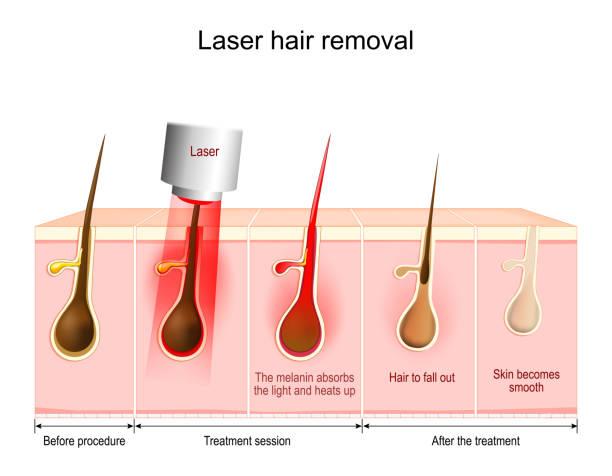
Device choice is based on natural and current skin color, Fitzpatrick skin type, hair color and diameter, tanning, leg zone, prior reactions, and response to earlier sessions—not on a device name alone.
- Alexandrite laser (755 nm) — Often used for light-to-medium skin tones with dark terminal hair. Its strong melanin targeting requires careful settings when skin is tanned or deeply pigmented.
- Diode laser (about 800–810 nm) — A common option across a range of skin types when paired with appropriate parameters and cooling. A 2023 network meta-analysis found diode laser reduced hair counts versus control but found no statistically significant efficacy difference among evaluated laser interventions.
- Long-pulsed Nd:YAG laser (1,064 nm) — Often considered for darker skin because it has lower relative absorption by epidermal melanin. A systematic review found promising efficacy and safety but stressed the need for stronger evidence to standardize photoepilation parameters.
- IPL (intense pulsed light) — IPL uses broad-spectrum light rather than one laser wavelength. It can reduce hair, but outcomes depend heavily on the platform and protocol; comparative axillary data cannot be assumed to predict leg results.
- Cooling and test spots — Contact cooling, chilled air, cryogen spray, or gel can protect the skin surface and reduce discomfort. A small test spot is useful when safe settings are uncertain, particularly after tanning or with prior pigment change.
A split-leg study in 30 Asian participants with Fitzpatrick III–IV skin found similar 12-month hair reduction after three sessions of a specific low-fluence multipass diode protocol and high-fluence single-pass IPL protocol, while the diode approach was less painful. This is limited leg-specific evidence, not a universal full-leg treatment protocol.
Why Visit Korea for Leg Laser Hair Removal?
South Korea has a formal system for registered institutions serving foreign patients, which gives international visitors a practical verification route before booking. That administrative safeguard does not establish better laser results than treatment elsewhere. Device suitability, clinician assessment, informed consent, and accessible adverse-event care remain the deciding factors.
- Foreign-patient registration check — Confirm that the institution appears in the Korea Medical registration system for foreign patients before arranging care.
- Continuity documentation — Request a legible English record listing the device and wavelength, treated zones, settings or parameter summary, cooling method, test-spot result, adverse events, aftercare, and recommended reassessment date. This is essential when the remaining sessions will occur at home.
- Evidence limitation — A randomized Korean study assessed diode-laser handpiece spot size for axillary, not leg, hair. It provides no basis to claim superior Korean leg-treatment efficacy or safety compared with appropriately delivered care elsewhere.
- Device-specific consultation — Ask in advance whether the planned device is alexandrite, diode, Nd:YAG, or IPL; whether it suits current skin color and hair characteristics; who performs or supervises treatment; and whether a test spot is available.
Key Information for International Patients
- Minimum stay — Plan 1–2 days for an in-person assessment, possible test spot, and one treatment session. Full-leg appointments take longer than lower-leg or thigh-only treatment, so confirm exactly which zones are included.
- Repeat visits — One trip rarely completes laser hair reduction. A series commonly uses 4–8 week intervals, adjusted for visible regrowth, skin recovery, device, and response; do not schedule further sessions around travel convenience alone.
- Flying — Same-day or next-day flying is generally practical after an uncomplicated, non-sedated session when feeling well, but this is not a formal evidence-based flight-clearance rule. Ask the treating clinician before flying with significant redness, blistering, pain, or prescribed topical or systemic medication.
- Itinerary impact — Formal downtime is not usually needed, but plan indoor, low-friction activities for the first 24–48 hours. Avoid beach days, tanning, hot baths, saunas, steam rooms, and strenuous exercise while the skin is warm or red.
- Remote follow-up — Obtain a written contact route for blistering, severe pain, crusting, drainage, spreading rash, fever, or marked pigment change. Send clear photographs only if the clinic requests them; urgent symptoms need in-person medical assessment.
- Records for home care — Keep the English treatment record and share it with the clinician continuing the course. The next provider needs to know the exact wavelength, settings, cooling approach, and skin response.
Travel note: No companion, recovery hotel, or special transport is usually required after routine treatment without sedating medication. Choose flexible travel plans because a concerning test-spot reaction or active skin problem can require deferring full-leg treatment.
Which Are the Best Clinics in Korea for Leg Laser Hair Removal?
Listed below are some of the best clinics in Korea for leg laser hair removal.
1. Three Wishes Clinic - Myeongdong
You may consider Three Wishes Clinic - Myeongdong for leg laser hair removal if you want a treatment that uses targeted laser energy to damage hair follicles for long-lasting reduction of unwanted hair. The clinic states that laser hair removal is suitable for almost all body areas, which can include the legs, though your treatment plan should be tailored to your needs.
- URL: Three Wishes Clinic - Myeongdong Website
- Location: Jung-gu, Seoul
- Laser hair removal:
- Uses targeted laser energy intended to destroy hair follicles and reduce unwanted hair over the longer term.
- The clinic describes the treatment as suitable for almost all body areas, supporting discussion of a leg-focused treatment area.
2. Secretclinic
At Secretclinic, you can expect laser hair removal intended to remove unwanted hair effectively with long-lasting results and minimal discomfort. The clinic also lists Clarity II, an upgraded laser treatment that includes hair-removal use, so you can ask how it may be used for your leg-hair concerns and treatment goals.
- URL: Secretclinic Website
- Location: Sujeong-gu, Seongnam-si, Gyeonggi
- Hair-removal options:
- The clinic lists laser hair removal for effective removal of unwanted hair with long-lasting results and minimal discomfort.
- Clarity II is listed as a laser treatment that offers hair removal as well as skin-elasticity, vascular-lesion, and skin-whitening applications.
- Treatment planning: The clinic describes its consultations and treatments as personalized, allowing your plan to be tailored to your individual needs.
3. Lalian Cheongdam Clinic
Lalian Cheongdam Clinic’s provided information focuses on facial aesthetic treatments, including energy-based lifting, injectables, skin boosters, and diagnostic assessment; it does not confirm that leg laser hair removal is offered. You may want to verify availability of leg hair removal directly before considering the clinic for this procedure.
- URL: Lalian Cheongdam Clinic Website
- Location: 2nd floor, Dosan-daero 59-gil, 9, Gangnam-gu, Seoul, South Korea
- Relevant planning resources:
- 3D skin analysis (Meta-Vu) is used to assess pores, wrinkles, pigmentation, and overall skin tone for treatment planning.
- Ultrasound examination is used to evaluate soft-tissue layers such as fat and muscle depth for more precise aesthetic treatment planning.
Leg Laser Hair Removal From Start to Finish
- First contact and virtual screening — Send the clinic details of the zones requested—lower legs, thighs, or full legs—plus natural skin tone, current tan, hair color, prior hair-removal treatments, medicines, skin conditions, and history of pigment change. Ask about English consultation, device type, test-spot policy, provider supervision, and treatment records.
- In-person assessment — The clinician examines the hair and skin rather than relying on photographs alone. They review sun exposure, self-tanner, pregnancy status, hormonal symptoms, prior laser or IPL reactions, scarring tendency, and medicines that can affect photosensitivity or skin healing.
- Consent and test spot when indicated — Discuss expected long-term reduction, the need for repeated sessions, pain, pigment change, burns, blistering, folliculitis, scarring, and rare paradoxical hair growth. A test spot can be performed and full treatment delayed if the response needs observation.
- Skin preparation — The legs are checked for cuts, sunburn, rash, bites, or infection, then cleaned. Hair is generally shaved or trimmed; protective eye shields are mandatory. Routine treatment does not use incisions, implants, general anesthesia, or sedation.
- Laser or IPL treatment — The clinician treats the agreed zones using selected parameters and cooling. Brief snapping, heat, and stinging sensations are common. Duration depends substantially on whether treatment covers calves only, thighs only, or both legs.
- Immediate review and discharge — Perifollicular redness, swelling, warmth, and a sunburn-like feeling are common. The clinic provides aftercare guidance, a contact method, and a record of the device, wavelength, zones, settings summary, cooling, and any test spot.
- Recovery and overseas follow-up — Redness and swelling usually settle within hours to 1–3 days. Treated hairs shed gradually over days to weeks, so do not judge the result immediately or pluck shedding hairs. Arrange reassessment and further treatment based on regrowth and skin recovery with a qualified provider in Korea or at home.
Alternatives to Leg Laser Hair Removal
Laser and IPL offer faster treatment across broad leg areas but depend on hair pigment and require repeated sessions. Electrolysis can permanently treat individual light hairs but is far slower for both legs. Temporary methods are useful between sessions, provided they do not remove follicles from the planned laser field.
Electrolysis
- Best use — Individual white, gray, red, blond, or very fine hairs that lack enough melanin for laser targeting.
- Tradeoff — It treats follicles one by one and is labor-intensive for full legs, but it is the more meaningful permanent-removal option for light hair.
Shaving or Trimming
- Best use — Fast temporary hair control before and between laser sessions.
- Tradeoff — It does not reduce future growth, but it preserves the follicle target and is generally compatible with a laser course once the skin is no longer sensitive.
Waxing, Sugaring, Epilators, or Threading
- Best use — Temporary removal outside a planned laser course.
- Tradeoff — These methods pull hair from the follicle and should be avoided in the planned treatment field during the clinician-specified follicle-preservation period.
Other Body Laser Areas
- Best use — Patients planning a wider hair-reduction program can compare body laser hair removal, arm laser hair removal, or underarm laser hair removal.
- Tradeoff — Each area has different hair density, sensitivity, treatment duration, and response; do not assume leg settings apply elsewhere.
How Can I Prepare for Leg Laser Hair Removal?
- Avoid tanning — Avoid direct sun, tanning beds, and self-tanner before treatment. Recent tanning interferes with skin assessment and increases the risk of epidermal injury or pigment change.
- Preserve the follicle — Do not wax, pluck, thread, sugar, or use an epilator or electrolysis on planned leg areas during the clinician-specified period before treatment. Shaving or trimming is generally permitted; confirm whether the clinic wants shaving the day before or on the day of treatment.
- Disclose medicines and supplements — Report all prescription and non-prescription medicines, herbal products, retinoids, isotretinoin, tetracycline-class antibiotics, anticoagulants, and products associated with photosensitivity or irritation. Do not stop prescribed medication unless the prescriber instructs you to do so.
- Arrive with intact skin — Keep the legs clean and free of sunburn, active eczema, folliculitis, open cuts, insect bites, and irritating body products. Report any new rash or infection before the appointment.
- Food and alcohol — Fasting is not usually required because routine treatment does not involve general anesthesia. Avoid alcohol if it worsens flushing or skin sensitivity for you, and follow clinic-specific instructions if topical anesthetic is planned.
- Clothing and transport — Bring or wear loose trousers or a long skirt to reduce friction afterward. Routine treatment without sedating medication does not usually require a driver or companion.
Travel note: Book treatment early enough in the trip to allow a test spot, assessment, or deferral if the clinician considers the skin unsafe after sun exposure. Avoid scheduling beach, spa, sauna, or outdoor sightseeing immediately afterward.
Confirm the treating doctor’s individualized preparation instructions, including hair-removal timing and medication guidance, because they take precedence over general advice.
Aftercare Advice
Protect reactive skin from heat, friction, and ultraviolet exposure until redness, warmth, and tenderness have fully settled.
- Cool the area gently — Use a cool compress wrapped in cloth for discomfort; never apply ice directly to treated skin. Temporary perifollicular redness and swelling commonly resolve within hours to 1–3 days.
- Reduce heat and sweating — Avoid strenuous exercise, hot baths, saunas, steam rooms, and intense heat for 24–48 hours or longer while the legs remain red or warm.
- Avoid friction and follicle removal — Wear loose clothing and do not scrub, pick, wax, pluck, thread, sugar, or use an epilator on treated hairs. Shave or trim only after sensitivity resolves.
- Use sun protection — Avoid direct sun and follow the clinician’s protection plan between sessions. Use broad-spectrum SPF 50 on exposed treated skin when advised, especially during outdoor travel.
- Expect delayed shedding — Treated hairs can appear to grow before shedding over days to weeks. This is not immediate hair disappearance and does not mean the session failed.
- Act on warning signs — Contact the clinic promptly for escalating pain, extensive or persistent redness, blistering, crusting, drainage, fever, spreading rash, or marked darkening or lightening of the skin. Paradoxical hypertrichosis is uncommon and lower on legs than the face or neck: a systematic review and meta-analysis estimated 0.08% prevalence in non-facial/non-neck sites, not zero risk.
Long-term outcomes cannot be predicted precisely: a 2022 systematic review found only five eligible long-term randomized trials involving 223 patients, with widely varying results across devices and protocols. Follow the treating doctor’s instructions and contact the clinic when anything appears wrong.
Frequently Asked Questions
Related Blogs
Abdominal Laser Hair Removal in Korea: Methods, Recovery, Sessions and Travel Planning
Abdominal laser hair removal uses laser or IPL pulses with cooling to reduce dark, coarse abdominal hair over 4–8 sessions spaced several weeks apart. The article covers candidate screening, preparation, aftercare, travel planning for Korea, device options, and warning signs requiring clinical assessment.
Updated: Sep 22, 2026
Chest Laser Hair Removal in Korea: Methods, Recovery, Treatment Course, and Travel Planning
Chest laser hair removal uses targeted light pulses to reduce dark, coarse hair over 4–8 sessions spaced about 6–8 weeks apart, with device selection based on skin tone, hair characteristics, and prior reactions. International patients can plan 1–2 days for consultation and treatment, obtain an English treatment summary, and avoid sun, heat, heavy exercise, and friction while the skin recovers.
Updated: Sep 22, 2026
Arm Laser Hair Removal in Korea: Methods, Results, Travel Timing, and Aftercare
Arm laser hair removal uses selected laser wavelengths and cooling to reduce pigmented, coarse hair over spaced sessions, with maintenance sometimes needed. International patients can plan a 1–2 day stay, prepare by avoiding tanning and follicle-removing methods, and arrange follow-up and later sessions near home.
Updated: Sep 22, 2026
Upper Lip Laser Hair Removal in Korea: Methods, Recovery, Risks, and Travel Planning
Upper lip laser hair removal uses cooling and laser pulses to reduce dark, coarse hair over repeated sessions typically spaced 4–6 weeks apart, with maintenance often needed for facial growth. The article covers candidate screening, device selection, Korea travel planning, preparation, aftercare, warning signs, and alternatives such as electrolysis for light or fine hairs.
Updated: Sep 22, 2026
Clinics offering Leg Laser Hair Removal

Three Wishes Clinic - Myeongdong, Korea: Advanced Botox, Fillers, Laser, and Skin Treatments for Confidence and Care
Myeongdong

VandS Dermatology Clinic - Dongtan, Korea: Comprehensive Skin Care and Cosmetic Procedures for Youthful, Radiant Skin
Hwaseong
VandS Clinic - Pangyo: Leading Advanced Medical Procedures in Korea for Enhanced Beauty and Health
Pangyo

Secret Clinic: Unveiling Advanced Skin and Body Treatments in Seongnam, Korea
Sinnonhyeon Station