
Medical Tourism Blog
Facial Botox in Korea: Treatment Areas, Recovery, Travel Planning, and Safety
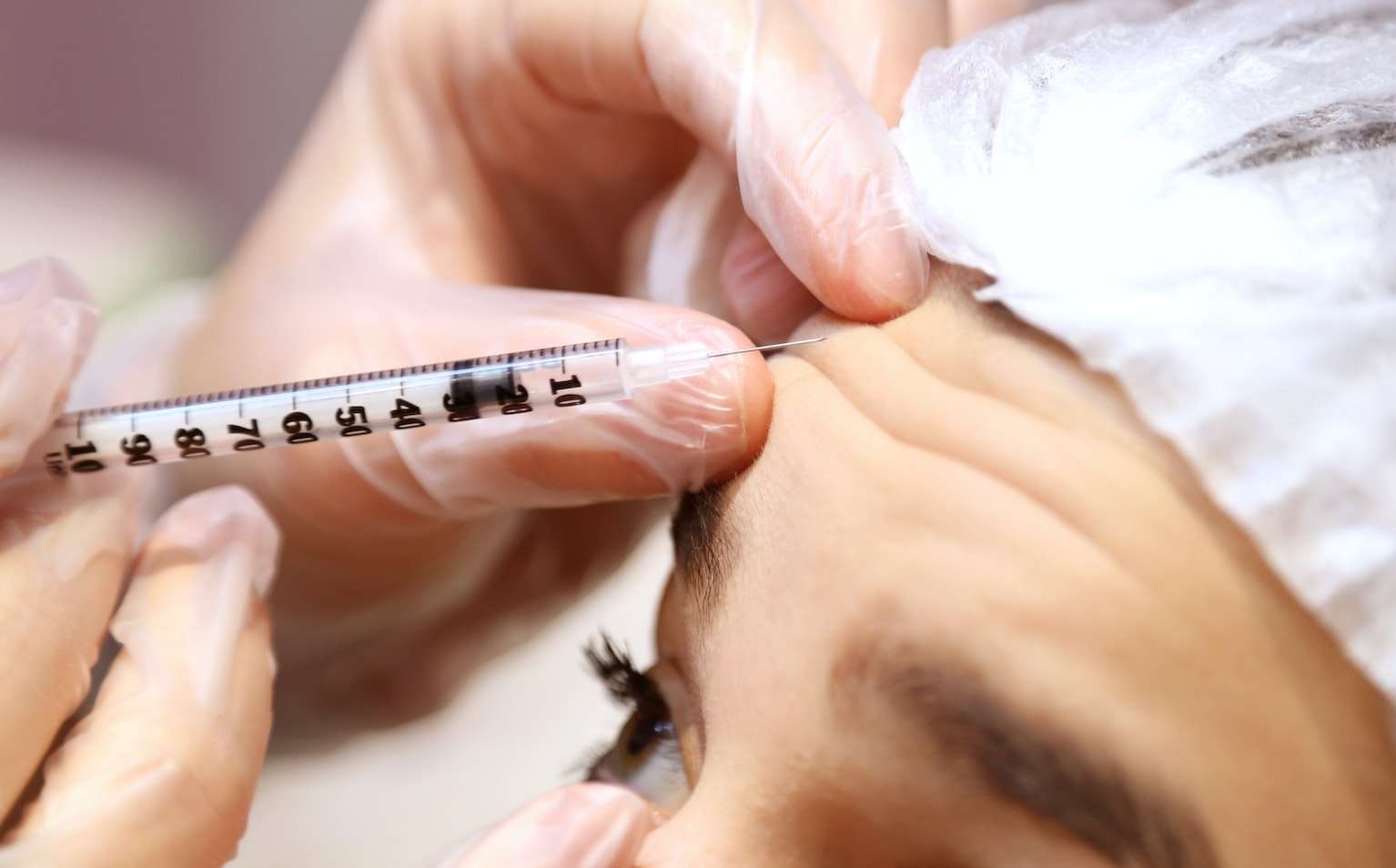
Table of contents
- Facial Botox at a Glance
- What Is Facial Botox?
- Who Is a Good Candidate for Facial Botox?
- How Is Facial Botox Performed?
- Why Visit Korea for Facial Botox?
- Key Information for International Patients
- Which Are the Best Clinics in Korea for Botox In?
- How Much Does Facial Botox Cost in Korea?
- Facial Botox From Start to Finish
- Alternatives to Facial Botox
- How Can I Prepare for Facial Botox?
- Aftercare Advice
Considering treatment in Korea? Everything you need to know e.g. — how to avoid scams, visas, interpreters, recovery tips — in our Medical Tourism Master Guide. Plan with confidence in minutes, not weeks!
Last updated: September 2026
Facial Botox at a Glance
- What it treats — Facial Botox uses botulinum toxin type A to temporarily relax selected muscles, softening dynamic lines from frowning, brow raising, squinting, or smiling; it does not replace lost volume, tighten loose skin, or reliably erase deep lines at rest.
- Typical cost — Facial Botox in Korea is typically quoted at ₩100,000–₩750,000 (about US$100–$600), with price driven by the product, treatment areas, total units, injection technique, and whether a two-week review or adjustment is included.
- Fast recovery — This is an awake outpatient treatment with same-day return to normal light activities; temporary redness, swelling, tenderness, headache, or bruising can occur, and a bruise may remain visible for about one week.
- Results and longevity — Early movement reduction is commonly noticeable in 3–7 days, but symmetry and final effect should be judged at about 14 days; cosmetic improvement usually lasts around 3–4 months.
- Best candidates — Adults with mild-to-moderate expression lines in the glabella, forehead, or crow’s feet are the clearest candidates, while masseter enlargement or chin dimpling may respond when excessive muscle activity—not volume loss or laxity—is the main cause.
- Important safety limit — Forehead and lower-face injections require anatomy-specific placement: an unfavorable plan can cause brow or eyelid droop, dry eyes, or smile, speech, chewing, lip-seal, or swallowing changes; urgent care is needed for breathing, swallowing, or speaking difficulty.
- Korea travel planning — One to two days in Korea is usually enough for consultation and injection, with no evidence-based mandatory delay before flying; plan a video or local clinician review around day 14, and request the exact product name, lot number, dilution, units, and injection-site record before departure.
What Is Facial Botox?
Facial Botox is an injectable treatment that temporarily relaxes selected facial muscles using botulinum toxin. It softens expression lines such as frown lines, forehead lines, and crow’s feet, and can address some muscle-related contour concerns. It is a minimally invasive treatment performed with small injections, typically without anesthesia or downtime.
Who Is a Good Candidate for Facial Botox?
- Adults with dynamic lines — Good candidates want to soften expression lines caused by frowning, raising the brows, squinting, or smiling, especially glabellar lines, forehead lines, and crow’s feet.
- Patients with muscle-driven contour concerns — Selected lower-face concerns, such as masseter enlargement or chin dimpling, can be considered when muscle activity rather than volume loss or skin laxity is the main cause.
- Realistic expectations — Facial botulinum toxin type A temporarily reduces selected muscle movement; it does not restore lost volume, remove loose skin, or reliably erase deep lines visible at rest.
- Conservative upper-face candidates — People who value some natural brow and forehead movement need an anatomy-based plan and a review at about two weeks rather than an aggressive first treatment.
Do not have elective treatment during pregnancy or breastfeeding, with an infection at a planned injection site, or with known hypersensitivity to the proposed product or its components. Known or suspected neuromuscular-junction disorders, including myasthenia gravis and Lambert-Eaton syndrome, require specialist assessment and are generally reasons to avoid cosmetic treatment because weakness can be amplified. Disclose swallowing or breathing problems, baseline facial weakness, previous eyelid or brow droop, dry-eye symptoms, facial surgery, asymmetry, and all previous toxin exposure. Forehead injections require particular caution where the frontalis muscle is compensating to keep heavy eyelids or low brows open; Korean expert guidance supports individualized placement and a patient-specific forehead no-injection zone.
How Is Facial Botox Performed?
Facial Botox is tailored by product, dose, dilution, injection depth, number of points, and muscle mapping. “Botox” is often used generically, but Botox Cosmetic is onabotulinumtoxinA; botulinum-toxin products and their units are not interchangeable.
- Upper-face muscle targeting — Glabellar frown lines, horizontal forehead lines, and lateral canthal lines or crow’s feet are the best-established cosmetic areas. In the United States, Botox Cosmetic is approved for adults with moderate-to-severe glabellar, lateral canthal, and forehead lines.
- Lower-face muscle modulation — Masseter reduction, gummy smile, chin dimpling, downturned mouth corners, bunny lines, and some lip-area treatments are commonly off-label, depending on the product and jurisdiction. Placement errors in this area can affect smile symmetry, lip seal, speech, chewing, or swallowing.
- Conservative movement reduction — The injector uses the smallest effective dose compatible with the agreed goal, especially around the forehead and eyes, where baseline brow height, eyelid position, and asymmetry determine ptosis risk.
- Superficial intradermal technique — “Skin Botox” or microdroplet treatment is placed more superficially than conventional muscle-targeted injections and is intended for skin-quality effects. Its evidence base remains limited: a 2024 systematic review included only 153 participants across 10 studies, so it should not be presented as a substitute for standard wrinkle treatment.
Why Visit Korea for Facial Botox?
South Korea has established infrastructure for overseas medical visitors and a broad aesthetic-treatment market. This supports access and practical coordination, but it does not prove better Botox results than other destinations. Select an injector based on facial assessment, product transparency, and follow-up planning—not a low unit price or a brand name alone.
- International-patient access — Medical Korea reports that about 1.17 million foreign patients from 202 countries received care in Korea in 2024. In its cumulative 2009–2024 department data, dermatology represented 23% and plastic surgery 12% of international-patient care.
- Anatomy-focused practice guidance — Published Korean guidance addresses dynamic examination, dose tailoring, injection depth, ptosis-risk reduction, and individualized forehead no-injection zones. This is relevant because safe forehead Botox depends on brow and eyelid anatomy, not a fixed injection map.
- Local product options — The English-language MFDS information for Botulax 50U, 100U, and 200U documents an adult glabellar-wrinkle indication. Ask for the current Korean label and approval status of the exact product offered; English-language official information was not identified for every formulation and facial use.
- Facility verification — Medical Korea advises foreign patients to verify a facility’s registration certificate) before booking. Registration supports lawful international-patient service, not an individual clinician’s expertise or a guaranteed outcome.
Key Information for International Patients
- Minimum stay — One to two days is normally sufficient for consultation and injection because this is an awake, outpatient procedure without routine recovery time. Stay 7–14 days when an in-person review or elective adjustment is a priority.
- Flight timing — There is no evidence-based mandatory delay before flying after uncomplicated botulinum-toxin treatment. An overnight stay is a useful logistical buffer, not a medical requirement.
- Itinerary impact — Normal non-strenuous activities usually resume the same day. Schedule treatment away from major photos, meetings, or events because pinpoint redness, swelling, tenderness, headache, or bruising can occur; a bruise can last about one week.
- Follow-up plan — Take standardized photographs before treatment and on days 7 and 14. Arrange a video review or a local qualified clinician review at about two weeks, when the result can be assessed reliably.
- Treatment record — Before leaving Korea, obtain the product name, lot number, dilution, total units, injection sites, injector credentials, written aftercare, and an urgent contact route. These details matter if an overseas clinician needs to assess asymmetry or an adverse effect.
Travel note: A companion is not normally required for Botox alone. Arrange one when sedation, anxiolytic medication, or another procedure is planned, or when the treating clinic requires an escort.
Which Are the Best Clinics in Korea for Botox In?
Listed below are some of the best clinics in Korea for botox in.
1. PangPang Clinic
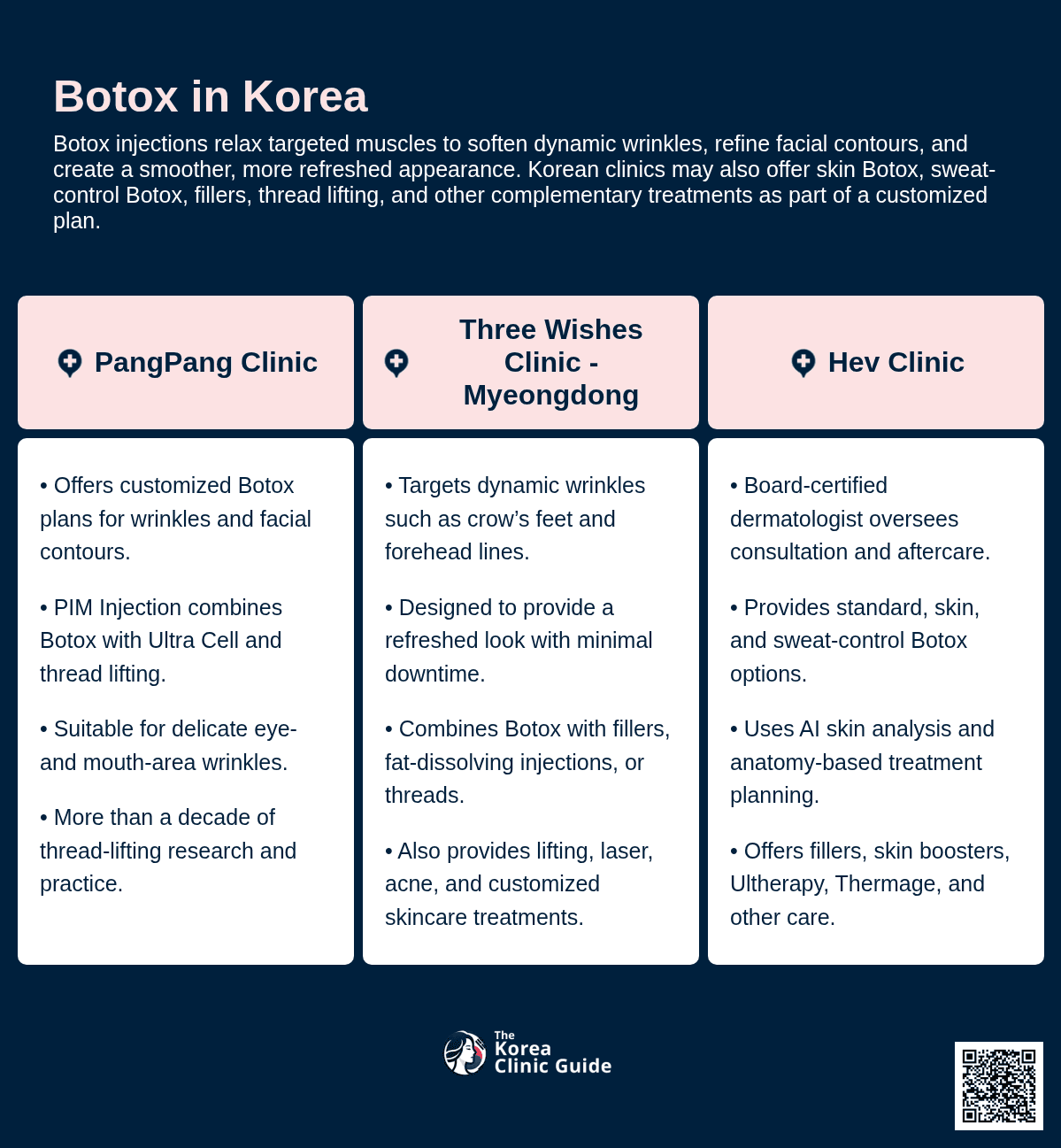
You may consider PangPang Clinic for Botox as part of a tailored non-surgical facial plan, particularly if you are also exploring thread lifting or treatment for facial contours and wrinkles. Its Botox offerings are described alongside personalized consultations, filler treatments, and a PIM Injection approach that combines Botox with Ultra Cell and thread-lifting components.
- URL: PangPang Clinic Website
- Location: Gangnam-gu, Seoul
- Botox and related options:
- Botox is offered within customized injectable treatment planning for wrinkle prevention and facial-structure enhancement.
- PIM Injection combines Ultra Cell, thread-lifting components, and Botox; it is described for delicate eye- and mouth-area wrinkles, facial volume, elasticity, and complexion.
- PIM Injection takes about 30 minutes with local anesthesia; the context states minimal pain and no recovery period, with results described as lasting 6 months to 2 years.
- Thread-lifting focus:
- The clinic has focused its research and practice on thread lifting for more than a decade and reports operating a Thread Lifting Research Institute.
- Its consultation center develops individualized plans, and the clinic describes using 31 specialized thread types.
- Thread lifting may be combined with fillers, Botox, or lasers in revision-focused care for unsatisfactory prior thread-lifting results.
2. Three Wishes Clinic - Myeongdong
You may consider Three Wishes Clinic - Myeongdong for Botox if you want an injectable treatment aimed at relaxing targeted facial muscles to soften dynamic lines such as crow’s feet and forehead lines, with minimal downtime. Botox can also be considered alongside fillers, fat-dissolving injections, or thread lifting when your goals include broader facial contouring or rejuvenation.
- URL: Three Wishes Clinic - Myeongdong Website
- Location: Jung-gu, Seoul
- Botox focus:
- Botox injections are described as relaxing facial muscles to reduce the appearance of dynamic wrinkles, including crow’s feet and forehead lines.
- The intended result is a more refreshed appearance with minimal downtime.
- Related facial treatments:
- Dermal fillers can add volume, smooth fine lines, and enhance areas such as the lips, cheeks, and chin.
- Fat-dissolving injections are offered for localized deposits in areas including the chin, jowls, and jawline.
- Thread lifting uses dissolvable threads to lift sagging tissue and stimulate collagen production.
- Skin-care options: Available treatments include Shurink ultrasound lifting, CO2 laser resurfacing, PDT acne treatment, chemical peels, Rejuran Healer, and customized skin-care treatments.
3. Hev Clinic
You may consider Hev Clinic for Botox when you want care overseen by the same board-certified dermatologist from consultation through aftercare. Botox is used to relax selected facial muscles for dynamic wrinkles and facial-contour refinement, while skin Botox and sweat-control Botox offer more targeted options for pores, fine lines, sebum, or hyperhidrosis.
- URL: Hev Clinic Website
- Location: Gangnam-gu, Seoul
- Botox options:
- Standard Botox targets selected facial muscles to soften dynamic wrinkles and refine facial contours; effects are described as beginning in 3–7 days and lasting about 3–4 months, with minimal downtime.
- Skin Botox, or micro-Botox, places superficial micro-droplets to refine pores, reduce sebum, and smooth fine lines without freezing expression; results are described as developing within a week and lasting around 3–4 months.
- Sweat-control Botox is offered for the underarms, palms, or soles; dryness is described as beginning within a week and lasting 4–6 months.
- Dermatologist-led planning:
- Dr. Shin Ji-yeon is a board-certified dermatologist whose stated focus includes well-aging, device-based lifting, dermal restoration, and customized non-surgical facial contouring.
- The clinic uses AI skin analysis to assess factors such as skin thickness, aging, and pigment depth for individualized planning.
- The context describes anatomy-based targeting intended to minimize nerve and vascular injury risk, along with a non-sedation pain-control system that permits real-time communication during treatment.
- Complementary treatments:
- Options include hyaluronic-acid fillers, Sculptra, Rejuran, Juvelook, Profhilo, PRP, and Re2O skin boosters.
- Lifting and tightening services include Ultherapy, Thermage, HIFU, InMode, and ONDA.
- A maintenance plan may be organized around a stated 3–4-week skin-cell regeneration cycle, with post-treatment care that includes the clinic’s Repair Barrier Cream.
How Much Does Facial Botox Cost in Korea?
Facial Botox is quoted at ₩100,000–₩750,000 (approximately US$100–$600). Individual quotes vary because the treatment plan can range from a limited upper-face injection pattern to multi-area or technically conservative facial muscle treatment.
| Procedure Price | Korean Won (₩) | USD ($) |
|---|---|---|
| Low Price | ₩100,000 | $100 |
| High Price | ₩750,000 | $600 |
Exchange rate as of 2026-09-06: 1 KRW = 0.000741 USD.
What Affects the Price?
- Treatment areas and total units — Treating only one area, such as the glabella, requires fewer injection points and less product than a plan covering the forehead, crow’s feet, masseters, chin, or other facial muscles. The exact formulation, total units, dilution, and number of sites determine product use and injection time; toxin units cannot be compared unit-for-unit across brands.
- Upper-face risk management versus lower-face treatment — Forehead and periocular treatment requires assessment of brow height, eyelid position, asymmetry, and compensatory forehead movement to reduce ptosis risk. Lower-face applications such as masseter, gummy-smile, chin, or mouth-corner treatment are often off label and require more detailed muscle mapping because inaccurate placement can affect chewing, speech, lip seal, or smile symmetry.
- Conventional muscle-targeted injections versus skin Botox — Superficial intradermal microdroplet or “skin Botox” uses a different injection plane and technique from conventional muscle-targeted wrinkle treatment. A plan that includes this technique requires its own placement pattern and consumable use rather than serving as a direct substitute for standard injections.
- Two-week review and adjustment planning — Results are assessed more reliably at about 14 days. A quote that includes an in-person review or elective adjustment requires scheduled follow-up time and additional product if treatment is adjusted; remote or local follow-up after travel uses a different care arrangement.
Cost tip: Request an itemized quote stating the product brand, total units, planned treatment areas, injection points or technique, consultation, follow-up or adjustment policy, and what is included. Obtain the product lot and treatment record after the procedure for overseas follow-up.
The US$100–$600 conversion is approximate, based on an exchange rate of 0.000741 KRW per USD on 2026-09-06. Check the exchange rate again when budgeting.
Facial Botox From Start to Finish
- Remote consultation and travel planning — Send clear, makeup-free front, oblique, and side photographs at rest and while raising the brows, frowning, squinting, smiling, clenching, and moving the lips as relevant. Confirm whether English-language or virtual consultation is available, then provide allergies, medicines, supplements, neurological history, previous toxin records, facial surgery history, dry-eye symptoms, and pregnancy or breastfeeding status.
- In-person facial assessment — The clinician examines facial movement, wrinkle depth, muscle bulk, asymmetry, brow height, eyelid position, skin quality, and whether the concern is caused by muscle contraction, volume loss, laxity, or a combination. Confirm the exact product, planned sites, total units, expected movement reduction, off-label status where relevant, and the plan for droop or asymmetry.
- Testing and consent — Routine blood tests, imaging, allergy testing, and fasting are generally unnecessary for an uncomplicated cosmetic injection. Review the consent form and disclose all previous botulinum-toxin treatment within the past four months.
- Injection treatment — The clinician cleanses the skin and often marks sites while the relevant muscles are activated. A fine needle delivers measured amounts into selected muscles or, for a specified skin Botox plan, a superficial plane. Ice or topical anesthetic can be used; general anesthesia and routine sedation are not customary.
- Discharge and immediate recovery — Leave shortly after treatment and return to ordinary light activities. Collect written aftercare and the full treatment record before departing Korea. Avoid rushing into an additional injection because day-one appearance does not predict the result.
- Result review from abroad — Early change is commonly visible in 3–7 days, with a more reliable assessment at about 14 days. Send standardized photos to the clinic or arrange qualified local review for persistent asymmetry, inadequate response, or an elective touch-up discussion.
Alternatives to Facial Botox
Choose an alternative based on the cause of the concern. Botox reduces muscle contraction; fillers replace selected volume, laser procedures target skin quality, and lifting procedures address laxity or tissue descent. Combination treatment is appropriate only when assessment identifies more than one cause.
Dermal Fillers
- Best for — Volume loss, structural contour, or static folds that remain visible without expression.
- Tradeoff — Fillers do not relax active muscles and carry different risks from toxin injections. Explore facial fillers or forehead fillers when volume rather than movement is the primary issue.
Laser Resurfacing
- Best for — Texture, fine static lines, superficial scarring, and pigment concerns.
- Tradeoff — Resurfacing does not stop repeated muscle folding and has more visible recovery than Botox. Options include CO2 laser treatment and Fraxel laser treatment.
HIFU or Surgical Lifting
- Best for — Skin laxity and tissue descent rather than expression lines.
- Tradeoff — Energy-based lifting has gradual, variable tightening; a facelift is surgery with substantially greater recovery and risk but can address significant descent. See HIFU lifting or a face lift.
Area-Specific Toxin Treatment
- Best for — A single defined concern rather than a full facial plan.
- Tradeoff — Area-focused treatment can limit unnecessary injections but still requires whole-face assessment for balance. Relevant options include forehead Botox, masseter Botox, and gummy smile Botox.
How Can I Prepare for Facial Botox?
- Medicines and supplements — Provide a complete prescription, over-the-counter, herbal, and injectable medication list before booking. Anticoagulants, antiplatelets, NSAIDs, fish oil or omega-3, vitamin E, ginkgo, garlic, ginseng, and similar products can increase bruising. Do not stop prescribed blood thinners, antiplatelets, muscle relaxants, or other medication without the clinician managing them.
- Drug interactions — Flag aminoglycoside antibiotics, curare-like neuromuscular blockers, and muscle relaxants because the Botox Cosmetic label warns these can potentiate toxin effects.
- Previous toxin — Report each botulinum-toxin treatment in the previous four months, including product, area, date, and units when known.
- Skin and health status — Postpone treatment for an infection, open wound, rash, herpes outbreak, or active inflammation in the planned injection area. Report facial surgery, dry eyes, prior drooping, weakness, or swallowing and breathing symptoms.
- Food, alcohol, and sun — Do not fast unless the clinic gives a separate instruction; routine facial Botox is performed awake. Clinics often ask patients to limit alcohol before treatment to reduce flushing or bruising, but no universal evidence-based interval exists. Use broad-spectrum SPF 30+ for photoaging prevention.
- Travel logistics — Keep flights flexible when possible and avoid booking immediately before an important event. No special accommodation or transport is typically needed.
Travel note: Avoid self-injection, salons, parties, and unverified online products. The AAD advises receiving cosmetic botulinum toxin from a qualified clinician in an appropriate medical setting.
Confirm the treating doctor’s clinic-specific requirements; individualized instructions take precedence over general guidance.
Aftercare Advice
Protect the injection sites, allow the result to develop for two weeks, and treat breathing, swallowing, or major visual symptoms as urgent medical issues.
- Touch and makeup — Do not rub, massage, or press aggressively on treated areas during the first day. Apply makeup gently.
- Activity and travel — Return to ordinary activity the same day; the AAD advises waiting two hours before strenuous exercise. Evidence does not support blanket restrictions on flying, pressure, or exercise after uncomplicated treatment, but follow stricter instructions for combined procedures or a clinician-identified concern.
- Expected short-term effects — Pinpoint redness, swelling, tenderness, headache, and small bruises can occur immediately. A bruise can remain visible for about one week.
- Result timing — Expect early effect in 3–7 days and judge symmetry and movement at around day 14. Cosmetic improvement commonly lasts about 3–4 months, depending on formulation, dose, treated muscle, and individual response.
- Warning signs — Contact the clinic promptly for a new uneven brow, eyelid droop, dry or watery eyes, or smile asymmetry. Seek urgent medical care for trouble breathing, swallowing, or speaking; generalized weakness; double vision or major visual symptoms; severe allergic symptoms; fever, drainage, or rapidly increasing redness and swelling; or inability to close an eye with marked irritation. Swallowing and breathing difficulties can be life-threatening.
Follow the treating doctor’s instructions and contact the clinic when anything appears wrong.
Frequently Asked Questions
Related Blogs
Discovering the Cost: Masseter Botox in Korea vs. USA, Mexico, Turkey, Thailand, and Australia
Discover the affordable and effective Masseter Botox treatments in Korea, renowned for their popularity in cosmetic enhancements. Learn about the costs, benefits, and why many choose Korea for this specialized procedure.
Updated: Oct 21, 2026
What Hyperhidrosis Botox Costs Globally: A Comparative Study of Korea, the USA, Mexico, and Beyond
Discover the cost of Hyperhidrosis Botox treatments in Korea, a popular solution for excessive sweating, offering an affordable yet effective option compared to global prices. Learn about pricing variations, treatment benefits, and how to find reputable clinics for a seamless experience.
Updated: Oct 18, 2026
Explore the Cost of Gummy Smile Botox: Why Korea Outshines the USA, Mexico, Turkey, and More
Discover the affordable world of Gummy Smile Botox treatments in Korea, where cutting-edge cosmetic procedures offer stunning results without breaking the bank. Learn about pricing, benefits, and what to expect from this increasingly popular smile-enhancing solution.
Updated: Oct 18, 2026
Mouth Corner Lift Botox in Korea: Candidacy, DAO Technique, Recovery, and Travel Planning
Mouth corner lift Botox uses targeted DAO injections, sometimes with platysma treatment, to temporarily soften muscle-driven downward mouth corners. The article covers candidacy, procedure steps, travel planning for Korea, aftercare, follow-up, risks, and alternatives for fixed folds or skin laxity.
Updated: Oct 18, 2026
Clinics offering Facial Botox
BongBong Plastic Surgery Dermatology Korea | Body, Breast & Aesthetic Treatments
Nonhyeon

365mc Hospital: Korea's Leading Liposuction and Body Contouring Clinic with Innovative AI Technologies and Comprehensive Patient Care
Gyodae

THEPLUS Plastic Surgery Korea | Eye, Nose, Face & Body Surgery
Sinsa

Haru Clinic Korea | Fully-Customized Full-Face Non-Surgical Rejuvenation With Threads, Botox & Fillers
Sinsa