
Medical Tourism Blog
IPL in Korea: Uses, Recovery, Safety, and Travel Planning
Table of contents
- IPL at a Glance
- What Is IPL?
- Who Is a Good Candidate for IPL?
- How Is IPL Performed?
- Why Visit Korea for IPL?
- Key Information for International Patients
- Which Are the Best Clinics in Korea for Ipl?
- IPL From Start to Finish
- Alternatives to IPL
- How Can I Prepare for IPL?
- Aftercare Advice
Considering treatment in Korea? Everything you need to know e.g. — how to avoid scams, visas, interpreters, recovery tips — in our Medical Tourism Master Guide. Plan with confidence in minutes, not weeks!
Last updated: September 2026
IPL at a Glance
- What IPL does — IPL is a non-ablative broad-spectrum flashlamp treatment, not a laser, used to target superficial sun spots and freckles, uneven pigmentation, diffuse redness or small vessels, and unwanted hair.
- Treatment course — Most goals require 3–6 sessions spaced about 2–4 weeks apart; hair reduction and skin improvement are cumulative, so a short trip usually cannot cover a full course.
- Recovery — Redness, warmth, mild stinging, and swelling usually settle within hours to 2–3 days; treated pigment spots often darken and flake over about 3–7 days, while treated hairs shed over 1–3 weeks.
- Best candidates — IPL is best suited to people with diagnosed superficial photodamage, freckles or lentigines, diffuse redness or small visible vessels, or dark coarse unwanted hair who can avoid sun exposure and attend repeat sessions.
- Pigment-risk planning — Recently tanned, darker, or pigment-prone skin may need conservative settings, cooling, and a test spot because epidermal melanin can increase the risk of burns or prolonged hypo- or hyperpigmentation.
- Korea travel planning — Treatment is outpatient with no established flight restriction after an uncomplicated session, but schedule early and remain locally for 24–48 hours when feasible; obtain English records with the device, filter, settings, and aftercare.
- Korea-specific evidence — A small Korean trial of 24 melasma patients found short-term benefit from fractionated IPL combined with low-fluence Q-switched Nd:YAG, but it does not establish a universal melasma protocol or inherently better IPL outcomes in Korea.
What Is IPL?
IPL, or intense pulsed light, uses filtered broad-spectrum light to target pigment, visible blood vessels, or hair follicles in the skin. It aims to gradually reduce sun spots, uneven tone, redness, small vessels, and unwanted hair. IPL is a non-surgical, non-ablative light-based treatment.
Who Is a Good Candidate for IPL?
- Pigment and sun-damage concerns — Good candidates have diagnosed freckles, solar lentigines (sun spots), mottled photodamage, or uneven superficial pigmentation and want gradual improvement over a course of treatments.
- Visible redness or fine vessels — IPL can target diffuse erythema and small telangiectasia. It is also used for selected erythematotelangiectatic rosacea, although it does not cure rosacea or replace medical care for inflammatory papules and pustules.
- Unwanted pigmented hair — Hair-removal IPL suits people seeking long-term hair reduction. Darker, coarser hair generally provides a clearer melanin target; results are cumulative because only follicles in the active growth phase respond.
- Realistic treatment-course plans — Suitable visitors can protect treated skin from sun exposure and arrange repeated sessions, commonly 3–6 treatments at intervals of about 2–4 weeks.
Delay IPL on sunburned, recently tanned, irritated, wounded, actively infected skin, or an active cold-sore outbreak in the treatment area. Pregnancy and breastfeeding generally warrant deferral of elective treatment because safety evidence is limited. Specialist assessment is necessary for photosensitivity disorders, flashing-light-triggered seizures, a history of keloids or poor scarring, recurrent herpes after light treatment, and pigment-prone skin. Darker skin is not automatically unsuitable, but epidermal melanin competes for energy, so conservative settings, cooling, and often a test spot are important; high-quality rejuvenation evidence has been limited to Fitzpatrick skin types I–IV in the available systematic review.
How Is IPL Performed?
IPL is a broad-spectrum flashlamp treatment, not a laser. The clinician selects filters, fluence (energy), pulse structure, cooling, and passes according to whether melanin, oxyhemoglobin, or hair follicles are the intended target.
- Pigment and photoaging IPL — Often called an IPL photofacial, this protocol targets freckles, lentigines, mottled photodamage, and uneven tone. Spots commonly darken before shedding over 3–7 days. A review of 16 studies involving 637 participants found improvement across pigment, redness, texture, pores, and photoaging measures, but protocols varied substantially and nine studies were low quality.
- Vascular and redness IPL — Filters and pulse settings target oxyhemoglobin in diffuse redness and small visible vessels. Diagnosis matters: rosacea, acne-related redness, melasma, and post-inflammatory hyperpigmentation require different plans.
- Hair-removal IPL — Pulses target melanin in anagen follicles for long-term hair reduction, not guaranteed removal of every hair. Shave the area rather than wax, tweeze, thread, or epilate it so follicles remain available as targets.
- Fractionated or combination IPL — Some devices deliver fractionated energy or are paired with another modality. A small Korean randomized trial of 24 people with melasma found greater short-term partial MASI reduction with fractionated IPL plus low-fluence Q-switched Nd:YAG than fractionated IPL alone after six sessions; its small sample and 1–2 month follow-up do not establish a universal melasma protocol.
Why Visit Korea for IPL?
Korea has published clinical research on low-fluence and combination light-based protocols for melasma. That is useful context, but it does not prove that IPL results in Korea are inherently superior. Device choice and parameter selection still need to match the diagnosis, skin tone, current tan, and pigment history.
- Korean IPL research — Korean investigators conducted the randomized fractionated-IPL melasma study comparing IPL alone with IPL plus low-fluence Q-switched Nd:YAG; the reported benefit was short-term and based on 24 participants.
- Protocol-focused consultation — A meaningful IPL plan identifies the target—pigment, vascular redness, photoaging, or hair—and documents the device, filter or wavelength range, fluence, pulse structure, cooling, eye protection, and endpoint rather than relying on the term “IPL” alone.
- Evidence limits — IPL studies use different devices, settings, session counts, outcome measures, and skin types. The systematic review found no consensus on optimal treatment parameters, so a clinic should not present one package or setting as right for every skin concern.
Key Information for International Patients
- Minimum stay — IPL is an outpatient treatment with no inherent overnight-stay requirement. Schedule consultation or a test spot and treatment early in the trip.
- Local recovery buffer — Remain locally for 24–48 hours when feasible so a clinician can assess an unexpected burn, blister, or marked swelling. This is sensible travel planning, not an evidence-based flight restriction.
- Flying and itinerary — There is no established IPL-specific prohibition on flying after an uncomplicated facial or body session. Do not plan treatment immediately before a beach holiday, prolonged outdoor activity, or an event where redness and darkened pigment spots would be difficult to manage.
- Course and repeat visits — A short Korea trip rarely accommodates a full course. Most indications require 3–6 sessions about 2–4 weeks apart; some melasma protocols use weekly sessions. Arrange subsequent treatment and follow-up with a qualified clinician at home.
- Transport and support — Routine IPL needs no fasting, sedation, escort, special transport, or hotel nursing. A companion is optional. Follow facility instructions and do not drive if oral anxiolysis, sedating medication, or an extensive combined procedure is planned.
- Records and remote follow-up — Obtain written English aftercare and a treatment record listing the diagnosis, device, filter, settings, pulse count, treatment map, and any complication. Confirm the clinic’s overseas contact route before leaving Korea.
Travel note: Cosmetic cutaneous IPL is different from ophthalmic IPL for dry-eye disease. Do not use dry-eye clinic instructions as a substitute for dermatologic IPL aftercare or flight advice.
Which Are the Best Clinics in Korea for Ipl?
Listed below are some of the best clinics in Korea for ipl.
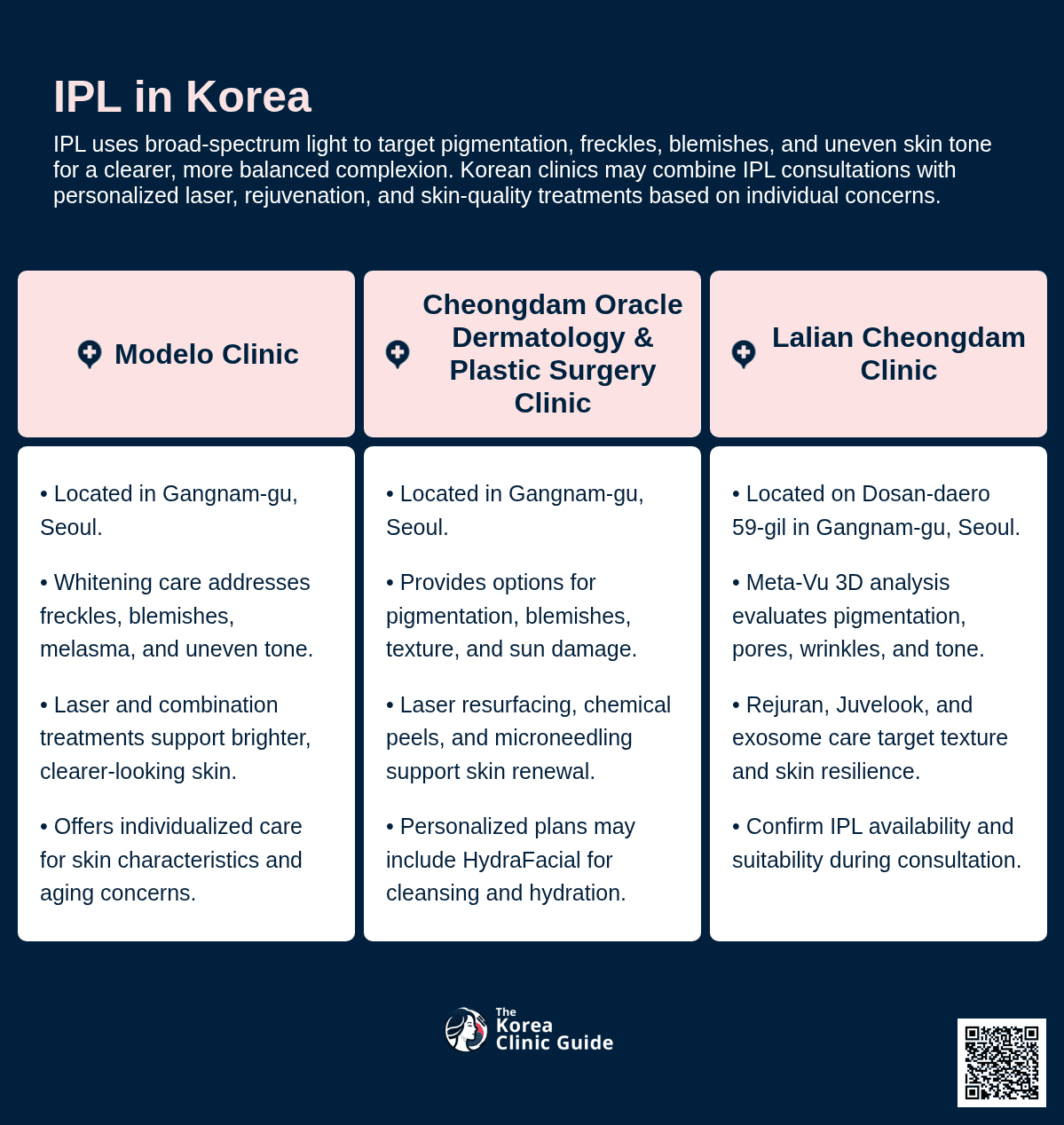
1. Modelo clinic
You may consider Modelo Clinic when your IPL goals include addressing freckles, blemishes, melasma, or uneven tone, as the clinic describes whitening care using laser and combination treatments tailored to improving skin clarity and brightness. Its emphasis on individualized skin characteristics and aging concerns may also be relevant when discussing a plan for your complexion needs.
- URL: Modelo clinic Website
- Location: Gangnam-gu, Seoul
- Skin concerns addressed:
- The clinic’s whitening treatments target freckles, blemishes, melasma, skin tone, and clarity.
- Laser and combination-treatment approaches are listed for brighter, more even-looking skin.
- Related aesthetic options:
- Lifting treatments are tailored to individual skin characteristics and aging concerns.
- Comfort Thermage uses radiofrequency energy for gradual skin tightening and smoothing.
2. Cheongdam Oracle Dermatology & Plastic Surgery Clinic
You may consider Cheongdam Oracle Dermatology & Plastic Surgery Clinic for a skin-focused consultation around IPL goals because it offers treatments for pigmentation, blemishes, texture, and sun damage, including laser resurfacing and chemical peels. You can expect a personalized treatment plan, with options that may be selected according to concerns such as uneven tone, mild scarring, wrinkles, or overall skin health.
- URL: Cheongdam Oracle Dermatology & Plastic Surgery Clinic Website
- Location: Gangnam-gu, Seoul
- Skin treatment options:
- Laser resurfacing is used to improve texture and address wrinkles, scars, and blemishes while promoting collagen formation and new skin growth.
- Chemical peels are used for sun damage, pigmentation, and mild scarring.
- Microneedling is offered to support collagen production, texture, and firmness.
- HydraFacial provides cleansing, exfoliation, and hydration for overall skin health.
- Planning considerations: The clinic states that treatment plans are personalized to individual aesthetic goals.
3. Lalian Cheongdam Clinic
You may consider Lalian Cheongdam Clinic if you want your IPL-related skin concerns assessed alongside detailed diagnostics and complementary skin-quality treatments: its Meta-Vu 3D skin analysis evaluates pigmentation, tone, pores, and wrinkles, while its regenerative and hydration-focused options address texture, resilience, dullness, and fine lines. The provided information does not specifically list IPL, so you would need to confirm whether it is available and appropriate for your needs.
- URL: Lalian Cheongdam Clinic Website
- Location: 2nd floor, Dosan-daero 59-gil, 9, Gangnam-gu, Seoul, South Korea
- Skin assessment:
- Meta-Vu 3D skin analysis assesses pores, wrinkles, pigmentation, and overall skin tone, helping track changes over time.
- Ultrasound examination evaluates soft-tissue layers, including fat and muscle depth, to support individualized planning.
- Skin-quality treatments:
- Rejuran Healer is described as supporting skin regeneration and improving texture, fine lines, pores, and resilience.
- Juvelook is a collagen-stimulating injectable aimed at gradual improvement in pores, fine lines, and uneven texture.
- Belotero Revive is used for hydration, glow, dryness, dullness, and texture concerns.
- ASCE+ exosome treatment is described by the clinic as supporting skin recovery, hydration, texture, and skin strength.
IPL From Start to Finish
- First contact and virtual consultation — Send clear, unfiltered photographs, state the exact concern and treatment area, and ask whether English consultation is available. Disclose previous pigment change, scars, cold sores, tanning, procedures, medical conditions, pregnancy or breastfeeding status, and every medicine and supplement.
- In-person assessment — The clinician examines the skin, confirms whether the concern is pigment, vascular redness, rosacea, hair, or another condition, and discusses expected improvement and risks. Photographs and, for pigment concerns, Wood-lamp assessment can help planning.
- Plan and test spot — Agree on the target, device, filter, fluence, pulse structure, cooling method, protective eyewear, expected endpoint, and number of sessions. Request a conservative test spot with delayed review when skin is darker, recently tanned, pigment-prone, or diagnostically uncertain.
- Treatment-day preparation — Arrive with clean skin free of makeup, sunscreen, self-tanner, and oils. Hair-removal areas are closely shaved. The provider uses eye protection appropriate to the area; this is mandatory, particularly near the eyes.
- IPL delivery — Gel is applied when required. The handpiece delivers brief flashes while cooling protects the surface of the skin. Treatment duration depends on the area and number of passes; a routine face or localized body session is commonly completed during one outpatient appointment.
- Immediate recovery and discharge — Cooling, bland moisturizer, and sunscreen are applied. Warmth, stinging, redness, and mild swelling are common immediately afterward; pigment spots can darken before flaking. Most uncomplicated sessions end with same-day discharge.
- Remote follow-up — Send requested photographs and report blistering, worsening pain, open skin, persistent pigment change, or eye symptoms promptly. Give the home clinician the English treatment record rather than asking them to reproduce settings without reassessment.
Alternatives to IPL
Alternatives depend on the diagnosis and target. IPL treats broad areas and can address pigment and vascular features in one plan, whereas lasers are more target-specific; both light-based choices can cause post-inflammatory pigment change, especially when skin is tanned or pigment-prone.
Pulsed-Dye Laser
- Best fit — A principal alternative for discrete telangiectasia and vascular redness.
- Tradeoff — More vessel-specific than IPL, but recovery and purpura risk depend on settings and treatment intensity. See V-Beam laser.
Pigment-Specific Laser Strategies
- Best fit — Consider when a clinician has diagnosed a pigment disorder requiring a targeted approach rather than broad-spectrum IPL.
- Tradeoff — Melasma and post-inflammatory hyperpigmentation need particularly cautious planning because aggressive energy treatment can worsen pigmentation. Relevant options include laser toning, pico toning, and pigmentation treatment.
Fractional Laser
- Best fit — More appropriate when texture, acne scarring, or more substantial photoaging is the primary concern.
- Tradeoff — Fractional resurfacing usually involves more downtime and a different risk profile than non-ablative IPL. See Fraxel laser.
Laser Hair Removal
- Best fit — Diode, alexandrite, and Nd:YAG systems are alternatives for unwanted hair.
- Tradeoff — Selection depends on hair color and diameter, skin tone, tanning, body area, and the operator’s ability to use conservative settings. See facial laser hair removal or body laser hair removal.
How Can I Prepare for IPL?
- Avoid tanning for 2–4 weeks — Avoid sunburn, tanning beds, intentional tanning, and self-tanner before treatment. Use broad-spectrum sunscreen and physical protection; the exact interval depends on skin type and the planned device.
- Disclose medicines and supplements — Send a complete list before booking, including doxycycline, minocycline, hydrochlorothiazide, amiodarone, retinoids, and non-prescription supplements. Photosensitizing medicines can increase reaction risk. Do not stop prescribed medication independently because no universal evidence-based washout interval exists.
- Protect irritated skin — Avoid scrubs, exfoliating acids, fragranced irritants, and topical retinoids on an already irritated treatment area unless the prescribing clinician instructs otherwise. Delay treatment for active infection, wounds, dermatitis flare, sunburn, or active herpes lesions.
- Prepare hair-removal areas correctly — Do not wax, tweeze, thread, or epilate for several weeks before hair-removal IPL. Shave shortly before the appointment only if instructed.
- Arrive clean — Remove makeup, sunscreen, self-tanner, and oils from the treatment area. Bring product labels or photographs of labels when the ingredient list is unclear.
- Plan around heat and sun — Avoid booking immediately before beach time, hiking, outdoor sport, sauna use, or a major event. Keep flights flexible enough to allow a 24–48-hour local buffer if a significant reaction occurs.
Travel note: Routine IPL does not require fasting, an escort, or hotel nursing. Follow the facility’s transport rules when sedation, oral anxiolysis, or combined procedures are planned.
Confirm the treating doctor’s clinic-specific preparation instructions, which take precedence over this general guidance.
Aftercare Advice
Treat new warmth, redness, swelling, and temporarily darkened pigment as healing skin: cool it, protect it from light and heat, and do not disturb it.
- Cool and moisturize — Use cool compresses and a bland, fragrance-free moisturizer. Do not apply ice directly to the skin.
- Protect from sun — Use broad-spectrum SPF 50 sunscreen and physical shade. Avoid direct sun throughout the treatment course and while brown spots are darkening or flaking.
- Avoid heat and friction for 24–48 hours — Skip vigorous exercise, hot baths, saunas, steam rooms, rubbing, and exfoliation until heat and redness settle. For rosacea-prone facial skin, also avoid personal flushing triggers such as alcohol, spicy food, and heat during this reactive period.
- Do not pick pigment spots — Darkened spots commonly flake over about 3–7 days. Picking raises the risk of prolonged pigment change and infection.
- Expect gradual hair shedding — After hair-removal IPL, treated hairs shed over roughly 1–3 weeks. Do not tweeze or wax between sessions; shaving is generally compatible with the treatment plan.
- Escalate warning signs promptly — Contact the clinic for increasing pain after the first day, marked swelling, blistering, crusting, open skin, pus, fever, widespread rash, persistent or worsening pigment change, or cold-sore symptoms. Seek urgent local care for eye pain, vision symptoms, or signs of a severe allergic reaction.
Follow the treating doctor’s individualized instructions and contact the clinic promptly when something appears wrong.
Frequently Asked Questions
Related Blogs
Nuviju in Korea: Treatment Process, Recovery, Safety, and Travel Planning
Nuviju is a prescription cholic-acid injection for adults with moderate-to-severe pinchable fat beneath the chin, delivered in a mapped series of preplatysmal-fat injections at least one month apart. The article covers candidacy screening, Korea travel planning, recovery reactions and warning signs, aftercare, and alternatives such as liposuction, neck lift, and deoxycholic acid.
Updated: Oct 13, 2026
Juveacell in Korea: Types, Safety, Recovery, and Travel Planning
Juveacell is a donor-derived hADM skin booster for gradual improvement in hydration, texture, fine lines, pores, elasticity, and dermal density, with 3% and 8% formulations documented by the manufacturer. Learn about candidate screening, injection steps, recovery, aftercare, product verification, and travel planning for treatment in Korea.
Updated: Oct 13, 2026
PRF Injection in Korea: Uses, Evidence, Recovery, and Travel Planning
PRF injections use a patient’s processed blood for facial skin or scalp treatment, typically through a series of superficial injections with short-term redness, swelling, or bruising. International patients should plan 2–3 days in Korea, arrange next-day and remote follow-up, verify the clinic’s processing protocol, and obtain English treatment records and emergency contact details.
Updated: Oct 13, 2026
Milia Under Eyes Treatment: Milia Removal Procedures in Korea for Clearer, Smoother Skin
Discover how Korea leads in safe, effective Milia removal techniques such as manual extraction, electrosurgery, and laser ablation. This blog explores the benefits of choosing Korea for milia treatment, offering advanced technology, skilled dermatologists, and affordable pricing. Perfect for medical tourists seeking quick, professional solutions to benign keratin cysts beneath the eyes and on the
Updated: Oct 12, 2026
Clinics offering IPL

Cheongdam Oracle Dermatology & Plastic Surgery Clinic in Korea: Offering Advanced Skin, Anti-Aging, Body Contouring Treatments and More
Seolleung

Modelo Clinic Korea: Achieving Timeless Beauty with Personalized Botox, Filler, Skincare Treatments & More
Apgujeong
Dao Clinic: Premier Dermatology and Aesthetic Treatments in Myeongdong, Korea, Catering Especially to Japanese Tourists
Myeongdong

Mi and Mi Clinic - Gangnam: Premier Beauty & Well-being Services in Korea
Gangnam Station