Medical Tourism Blog
Gummy Smile Surgery in Korea: Causes, Treatment Methods, Recovery and Travel Planning
Table of contents
- Gummy Smile Surgery at a Glance
- What Is Gummy Smile Surgery?
- Who Is a Good Candidate for Gummy Smile Surgery?
- How Is Gummy Smile Surgery Performed?
- Why Visit Korea for Gummy Smile Surgery?
- Key Information for International Patients
- Which Are the Best Clinics in Korea for Gummy Smile Surgery?
- Gummy Smile Surgery From Start to Finish
- Alternatives to Gummy Smile Surgery
- How Can I Prepare for Gummy Smile Surgery?
- Aftercare Advice
Considering treatment in Korea? Everything you need to know e.g. — how to avoid scams, visas, interpreters, recovery tips — in our Medical Tourism Master Guide. Plan with confidence in minutes, not weeks!
Last updated: September 2026
Gummy Smile Surgery at a Glance
- Cause-led treatment — Gummy smile surgery is a treatment category, not one operation: excess gum may arise from altered tooth eruption, gum tissue, a hypermobile lip, tooth position, upper-jaw excess, or multiple causes.
- In-person diagnosis required — Do not commit to irreversible gum removal from photographs alone; periodontal measurements, tooth and bone assessment, bite analysis, and lip evaluation are needed to select the right treatment.
- Several treatment paths — Options range from outpatient gingivectomy or crown lengthening and lip repositioning to months or years of orthodontics, while confirmed vertical maxillary excess may require Le Fort I jaw surgery under general anesthesia.
- Recovery and results — Gum contour changes are immediately visible but mature over weeks to months; lip repositioning reduced gum display by an average 3.06 mm at 6 months and 2.76 mm at 36 months, though recurrence can occur.
- Korea stay planning — Plan 3–5 days for simple gum reshaping, about 7–10 days for crown lengthening with bone work or lip repositioning, and at least 3–4 weeks for Le Fort I or double-jaw surgery.
- Continuity matters — Braces, aligners, and TAD-supported intrusion need repeated adjustments over months to years, so they are not suitable for a one-off Korea trip without written agreement from a home orthodontist to continue care.
- Korea-specific consideration — Korea has established international-patient coordination, but no reliable comparative evidence shows superior safety, durability, relapse rates, or satisfaction for gummy-smile treatment versus other countries.
What Is Gummy Smile Surgery?
Gummy smile surgery is a cause-based group of treatments that reduces excessive gum showing during a full smile. It aims to create a more balanced appearance between the teeth, gums, lips, and face when this is a patient concern. Treatment ranges from minimally invasive or surgical gum and lip procedures to non-surgical orthodontics, while selected jaw-related cases require major surgery.
Who Is a Good Candidate for Gummy Smile Surgery?
- Cause-matched concerns — Good candidates have a documented reason for excessive gingival display: altered passive eruption, excess gum tissue, a hypermobile upper lip, tooth-position problems, vertical maxillary excess, or a combination of these.
- Healthy periodontal foundation — Candidates have controlled plaque, no active gum disease or dental abscess, stable teeth, and enough healthy gum and supporting bone for any proposed contouring or crown-lengthening procedure.
- Realistic cosmetic goal — Good candidates want better balance between the upper teeth, gums, lips, and face rather than a predetermined millimeter measurement. Perception research shows that acceptable gum display varies substantially between observers and facial contexts.
- Commitment to the right pathway — Suitable patients accept that treatment can range from a local-anesthetic gum procedure to months of orthodontics or hospital-based jaw surgery, depending on the diagnosis.
Do not proceed from photographs alone or agree to gum removal without periodontal measurements, tooth proportions, bone-level assessment, bite analysis, and lip evaluation. Active gingivitis or periodontitis, untreated decay, medication-related gum enlargement, poor oral hygiene, uncontrolled diabetes, major bleeding disorders, significant immunosuppression, and unstable cardiopulmonary disease require assessment and stabilization first. Current or previous antiresorptive medication, head-and-neck radiotherapy, smoking or vaping, and heavy alcohol use require a specific healing-risk plan. Definitive orthognathic correction should wait until facial growth is complete; elective invasive treatment is usually deferred during pregnancy when sedation, general anesthesia, extensive imaging, or elective medication is involved. Mixed causes are common: a 2024 adult study found 55.3% had more than one identified cause, so a staged multidisciplinary plan is often more appropriate than one cosmetic procedure.
How Is Gummy Smile Surgery Performed?
Gummy smile surgery is not one standard operation. The clinician should first determine whether the visible gum comes from the gums, tooth position, upper-lip movement, jaw position, or several factors together.
- Gingivectomy and gingivoplasty — The clinician removes and reshapes excess soft gum around the upper front teeth, usually under local anesthesia. This suits limited soft-tissue excess only when the teeth are proportionate and removing tissue will not compromise periodontal attachment or expose roots excessively.
- Esthetic crown lengthening — For altered passive eruption, the periodontist exposes more natural enamel. When bone sits too close to the planned gumline, the procedure involves lifting the gum, reshaping a measured amount of supporting bone, and repositioning the tissue. It is more invasive than superficial gum contouring.
- Lip repositioning — The surgeon removes a strip of inner-lip mucosa and sutures the lip to reduce its upward movement during smiling. This targets a hypermobile upper lip; it does not move teeth or correct a vertically excessive upper jaw. A meta-analysis found an average gingival-display reduction of about 3.06 mm at six months and 2.76 mm at 36 months, but recurrence can occur and the studies used varied techniques.
- Orthodontics with or without TADs — Braces or clear aligners can correct selected deep bites, incisor overeruption, and dentoalveolar vertical problems. Temporary anchorage devices (TADs, or miniscrews) can support tooth intrusion. This requires ongoing orthodontic care over months to years, not a short treatment trip.
- Le Fort I maxillary impaction — An oral and maxillofacial surgeon moves the upper jaw upward through an osteotomy and secures it with plates and screws, sometimes as part of double-jaw surgery. This is the skeletal option for confirmed vertical maxillary excess or significant jaw-and-bite discrepancy; it requires coordinated orthodontics and general anesthesia. A systematic review describes orthognathic surgery as the durable option for relevant skeletal cases while noting the need for stronger long-term comparative research.
Why Visit Korea for Gummy Smile Surgery?
Korea can be practical for an in-person multidisciplinary dental assessment and minor outpatient treatment when travel timing allows an early review. Its established international-patient systems can help with coordination and records access. These advantages do not prove that Korean treatment has superior safety, durability, relapse rates, or satisfaction outcomes.
- International-patient infrastructure — The Medical Korea platform provides national-level information for overseas patients seeking Korean medical services.
- Established cross-border care activity — Seoul reported more than one million international medical tourists in 2024. This supports the availability of international-patient services, but it is not procedure-specific outcome evidence.
- Relevant specialist coordination — A cause-based gummy-smile work-up can involve periodontics, orthodontics, prosthodontics, and oral-maxillofacial surgery. Ask in advance which specialist will make the diagnosis and who is responsible for each stage.
- Evidence limitation — No reliable comparative research shows that Korea performs better than other countries for gum contouring, crown lengthening, lip repositioning, orthodontic intrusion, or jaw surgery for excessive gingival display.
Key Information for International Patients
- Minimum stay — Plan 3–5 days for simple local-anesthetic gingivectomy or gingivoplasty where feasible. Plan roughly 7–10 days for flap-and-bone crown lengthening or lip repositioning, allowing early wound assessment and suture review. Plan at least 3–4 weeks for Le Fort I or double-jaw surgery.
- Flight timing — There is no universal evidence-based interval for flying after these procedures. Bleeding, infection risk, hydration, airway status, diet tolerance, operative extent, and the operating surgeon’s clearance determine fitness to fly. Do not book a non-changeable return flight before the in-person plan is confirmed.
- Orthodontic continuity — Braces, aligners, and TAD-based intrusion require repeated adjustments. Do not start orthodontics in Korea as a one-off trip unless an orthodontist at home has agreed in writing to continue treatment and receive records.
- Itinerary impact — A gum procedure can fit a short visit but still needs quiet recovery, soft foods, and access to the clinic. Lip repositioning limits lip movement and exaggerated smiling early on. Jaw surgery requires a prolonged stay, restricted diet, frequent reviews, and no sightseeing-focused itinerary.
- Remote follow-up — Arrange a direct contact method, secure copies of imaging and operative notes, and a video follow-up schedule before departure. For jaw surgery, confirm home-country oral-maxillofacial and orthodontic follow-up before traveling.
Travel note: Treat “gummy smile surgery” as a diagnosis-led treatment category, not a single vacation procedure. A remote consultation can organize travel, but it cannot replace periodontal probing, bite examination, and imaging when needed.
Which Are the Best Clinics in Korea for Gummy Smile Surgery?
Listed below are some of the best clinics in Korea for gummy smile surgery.
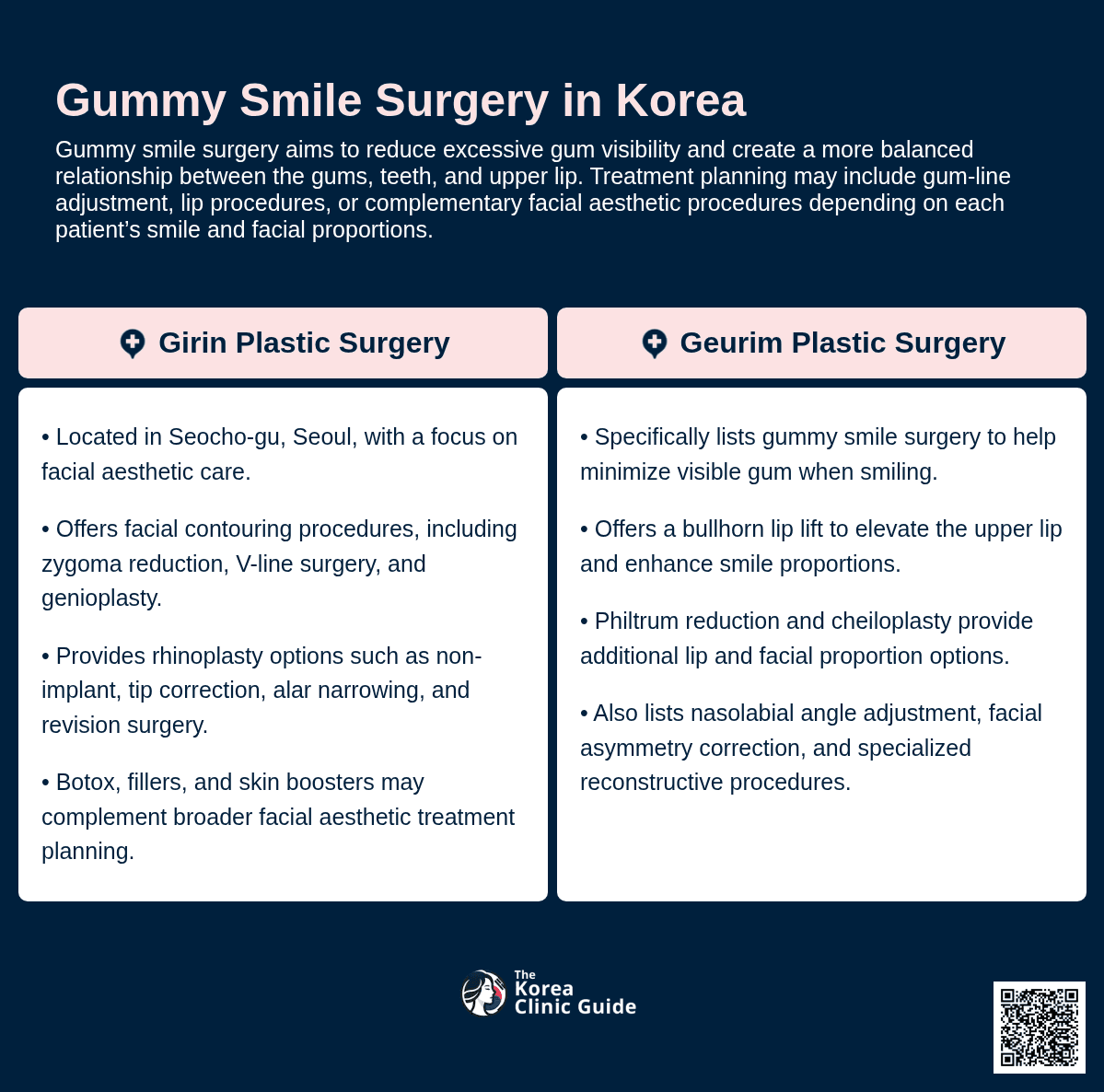
1. Girin Plastic Surgery
You may consider Girin Plastic Surgery if you are seeking facial aesthetic care in Seoul, but the provided information does not specifically confirm that it offers gummy smile surgery or describe a gummy-smile technique. Its listed services do include procedures that can be relevant to overall facial balance, such as rhinoplasty, genioplasty, facial contouring, and lip-area injectable treatments.
- URL: Girin Plastic Surgery Website
- Location: Seocho-gu, Seoul
- Related facial aesthetic services:
- Facial contouring options include zygoma reduction, V-line surgery, and genioplasty.
- Nasal procedures include non-implant rhinoplasty, tip correction, alar narrowing, and revision rhinoplasty.
- Botox, fillers, and skin boosters are listed among the non-surgical services.
2. Geurim Plastic Surgery
You may consider Geurim Plastic Surgery for gummy smile surgery because the clinic specifically lists this procedure to adjust the gum line and reduce gum visibility when you smile. Its additional lip and smile procedures may also be relevant when you want to discuss facial proportions and the appearance of the upper lip as part of your treatment planning.
- URL: Geurim Plastic Surgery Website
- Location: Seoul
- Gummy smile procedure: Gummy smile surgery is listed as a procedure intended to minimize visible gum line when smiling.
- Lip and smile options:
- Bullhorn lip lift is offered to elevate the upper lip and enhance the smile.
- Philtrum reduction surgery is listed to shorten the philtrum and adjust facial proportions.
- Cheiloplasty is available for lip reshaping with aesthetic and functional considerations.
- Related facial procedures:
- Nasolabial angle adjustment is listed for changes to the relationship between the nose and upper lip.
- Facial asymmetry correction and double jaw surgery are among the available facial procedures.
- Cleft lip and cleft palate surgery are listed within the clinic’s specialized reconstructive procedures.
Gummy Smile Surgery From Start to Finish
- First contact and remote screening — Send full-face photos, an unfiltered full-smile video, recent dental X-rays and orthodontic records if available, medical history, allergies, and a complete medication and supplement list. Ask for a provisional diagnosis rather than a guaranteed procedure or final quote.
- Virtual consultation and travel plan — Discuss whether the concern appears gum-, lip-, tooth-, or jaw-related and whether the clinic can communicate in English. Confirm the treating clinician’s specialty, proposed rationale, expected stay, anesthesia setting, emergency contact route, records release, and follow-up plan.
- In-person diagnostic assessment — The clinician evaluates lips at rest and full smile, gum display, tooth width and visible crown length, periodontal probing, oral hygiene, bite, and tooth position. Dental radiographs and CBCT are used only when clinically justified; suspected skeletal discrepancy needs orthodontic and cephalometric or three-dimensional assessment.
- Final treatment decision — The team explains whether the plan is gingivectomy, crown lengthening, lip repositioning, orthodontics, jaw surgery, or staged treatment. Confirm what the procedure cannot correct, the expected amount of remaining gum display, alternatives, risks, costs, and what finding would change the plan.
- Procedure day — Gum contouring, crown lengthening, and lip repositioning are generally outpatient procedures under local anesthesia, with sedation only when indicated. Gingivectomy is often brief; crown lengthening takes longer when flap surgery and bone reshaping are required. Le Fort I and double-jaw surgery take place in hospital under general anesthesia.
- Discharge and early recovery — Receive written instructions, prescriptions, copies of imaging and the operative note, and an urgent-contact number. Minor procedures usually require soft foods and careful oral hygiene for several days; lip repositioning also requires avoiding lip traction and forceful smiling. Jaw-surgery patients need close hospital and outpatient monitoring, diet progression, orthodontic coordination, and surgeon-directed flight clearance.
- Review and overseas follow-up — Attend the early in-person review before leaving Korea when advised. Continue remote check-ins after return, send requested wound or smile photographs, and transfer records promptly to the home dentist, periodontist, orthodontist, or oral-maxillofacial surgeon.
Alternatives to Gummy Smile Surgery
The appropriate alternative depends on the cause. Non-surgical approaches avoid incisions or jaw surgery but have limits and often need repeated or prolonged treatment; surgical correction can address anatomy directly but involves greater recovery, risk, and follow-up needs.
Periodontal Treatment
- Cleaning and disease control — Professional cleaning and periodontal therapy come first when inflammation, plaque accumulation, or medication-related enlargement contributes to the gum display.
- Tradeoff — This improves diseased or swollen gums but does not correct a hypermobile lip, tooth-position problem, or vertical maxillary excess.
Botulinum Toxin
- Hypermobile-lip option — Gummy smile Botox temporarily reduces upper-lip elevation in selected patients.
- Tradeoff — It requires repeat treatment and does not correct altered passive eruption, tooth position, or skeletal jaw excess.
Orthodontic Correction
- Tooth-position treatment — Braces or clear aligners, sometimes with TADs, can address selected deep bite and incisor-overeruption patterns.
- Tradeoff — Treatment takes months to years and needs continuous orthodontic supervision, but it avoids unnecessary gum or jaw surgery when teeth are the main cause.
Gum Contouring
- Limited soft-tissue change — Gum contouring can be suitable for localized excess soft tissue when bone and attachment anatomy permit.
- Tradeoff — It cannot safely substitute for crown lengthening where bone is too close to the intended gumline or for treatment of lip- and jaw-driven display.
Orthognathic Surgery
- Skeletal correction — Double-jaw surgery can include maxillary impaction for substantial vertical maxillary excess with a meaningful bite or facial skeletal discrepancy.
- Tradeoff — It is the most invasive option, requires orthodontic coordination and extended recovery, and is not justified for a mild gum-display concern without a skeletal indication.
How Can I Prepare for Gummy Smile Surgery?
- Provide complete records — Send prior dental radiographs, periodontal charts, orthodontic records, restorations history, full medication and supplement list, allergies, smoking or vaping history, and medical diagnoses. Disclose antiresorptive medicines, immunosuppressants, diabetes, bleeding conditions, previous radiotherapy, and prior jaw surgery.
- Stabilize oral disease — Complete treatment for active decay, abscess, gingivitis, or periodontitis before elective cosmetic surgery. Follow the clinician’s plaque-control instructions; cosmetic reshaping is not a substitute for disease treatment.
- Discuss medicines before stopping them — Tell the clinician about aspirin, warfarin, direct oral anticoagulants, clopidogrel, NSAIDs, corticosteroids, and supplements such as fish oil, vitamin E, ginkgo, garlic, and ginseng. Do not stop prescribed anticoagulants or antiplatelet drugs independently; the prescribing doctor and treating surgeon must set the plan.
- Follow fasting instructions exactly — Local-anesthetic gum treatment often does not require fasting. Sedation and general anesthesia do. Follow the anesthesia team’s specific food, drink, and medication instructions rather than a generic fasting rule.
- Avoid nicotine and alcohol — Stop smoking, vaping, and other nicotine exposure according to the treating clinician’s schedule, and avoid alcohol around surgery as directed. Both can complicate healing and medication safety.
- Arrange recovery logistics — Book accommodation near the clinic, keep the schedule flexible, and organize an adult escort if sedation or general anesthesia is planned. Prepare soft foods and reliable phone access for postoperative contact.
- Plan travel conservatively — Leave enough time for the planned review and do not arrange a tightly scheduled departure. Jaw-surgery patients need confirmed local accommodation, a companion when required, and home-country specialist follow-up before travel.
Travel note: Ask for the written diagnosis, procedure rationale, anesthesia plan, estimated review dates, and flight-clearance criteria before paying for travel.
Confirm the treating doctor’s individualized preparation requirements, which take precedence over general guidance.
Aftercare Advice
Protect the surgical site and attend planned reviews; early swelling or an uneven appearance is not the final cosmetic result.
- Food and hydration — Use soft, cool-to-lukewarm foods after gum or lip procedures and avoid sharp, hard, sticky, crumbly, and highly spicy foods while tissues are tender. After jaw surgery, follow the surgeon’s staged liquid-to-soft diet exactly and maintain hydration.
- Oral hygiene — Take prescribed pain medicine, antibiotics, and mouth rinses exactly as directed. Keep the mouth clean, but do not brush or floss aggressively over a surgical area until the clinician authorizes it.
- Protect the lip incision — After lip repositioning, do not pull the upper lip to inspect the wound. Avoid exaggerated smiling, forceful lip movement, straws, and strenuous exercise for the interval set by the surgeon.
- Avoid healing disruptors — Do not smoke, vape, use nicotine, or drink alcohol during the healing interval specified by the treating team. Avoid contact or pressure on healing gum and lip areas.
- Manage activity and sun exposure — Rest during the first days after minor procedures and avoid strenuous exercise until cleared. After jaw surgery, follow the surgeon’s restrictions on activity, nasal precautions, mouth opening, and orthodontic elastics. Use SPF 50 on exposed facial skin during recovery when outdoors, especially where bruising or swelling is present.
- Know urgent warning signs — Contact the clinic urgently for uncontrolled bleeding, fever, pus or foul drainage, rapidly increasing or one-sided swelling, severe worsening pain, dehydration, breathing difficulty, a sudden bite change, or concern that orthodontic elastics affect the airway.
- Judge results at the right time — Gum contour changes are visible immediately but gum maturation takes weeks to months. Lip repositioning needs months of observation because recurrence is possible; the best available evidence reports average improvement through 36 months but not definitive longer-term durability. Jaw-surgery outcomes evolve over months alongside orthodontic finishing.
Follow the treating doctor’s specific instructions and contact the clinic promptly when anything appears wrong.
Frequently Asked Questions
Related Blogs
Varicose Vein Treatment in Korea: Methods, Recovery, Travel Planning, and Safety
Varicose vein treatment begins with standing duplex ultrasound mapping and may use laser or radiofrequency ablation, vein glue, mechanochemical ablation, foam sclerotherapy, phlebectomy, or surgery based on anatomy and risk factors. The article covers candidacy, recovery, compression and walking guidance, follow-up, warning symptoms, and travel planning including flight restrictions after treatmen
Updated: Sep 19, 2026
Hyperhidrosis Laser in Korea: Methods, Recovery, Results, and Travel Planning
Laser treatment for primary axillary hyperhidrosis uses subdermal fiber ablation through tiny incisions or surface laser sessions to reduce underarm sweating, with repeat treatment sometimes needed. The article covers candidacy, Korea travel planning, preparation, recovery, warning signs, follow-up, and alternatives such as antiperspirants, Botox, microwave thermolysis, and gland removal.
Updated: Sep 18, 2026
Hyperhidrosis Surgery in Korea: ETS Methods, Risks, Recovery, and Travel Planning
Endoscopic thoracic sympathectomy (ETS) uses small chest ports under general anesthesia to permanently interrupt the sympathetic chain for severe primary palmar sweating after non-surgical treatments have failed or are not tolerated. International patients should plan 7–10 postoperative days in Korea, attend follow-up before flying, obtain flight clearance if pleural air is a concern, and arrange
Updated: Sep 18, 2026
Ear Plastic Surgery in Korea: Types, Recovery, Travel Planning and Aftercare
Ear plastic surgery includes otoplasty for prominent ears, earlobe repair, and diagnosis-specific reconstruction for conditions such as microtia, cryptotia, trauma, or constricted ears. The article explains candidacy, techniques, recovery, aftercare, international travel planning, and the recommended 7–10-day Korea stay for uncomplicated routine otoplasty.
Updated: Sep 18, 2026