Medical Tourism Blog
Varicose Vein Treatment in Korea: Methods, Recovery, Travel Planning, and Safety
Table of contents
- Varicose Vein Treatment at a Glance
- What Are Varicose Vein Treatment?
- Who Is a Good Candidate for Varicose Vein Treatment?
- How Are Varicose Vein Treatment Performed?
- Why Visit Korea for Varicose Vein Treatment?
- Key Information for International Patients
- Which Are the Best Clinics in Korea for Sclerotherapy?
- Varicose Vein Treatment From Start to Finish
- Alternatives to Varicose Vein Treatment
- How Can I Prepare for Varicose Vein Treatment?
- Aftercare Advice
Considering treatment in Korea? Everything you need to know e.g. — how to avoid scams, visas, interpreters, recovery tips — in our Medical Tourism Master Guide. Plan with confidence in minutes, not weeks!
Last updated: September 2026
Varicose Vein Treatment at a Glance
- What it treats — Varicose vein treatment closes or removes refluxing superficial leg veins to relieve symptoms such as aching, heaviness, swelling, itching, skin damage, bleeding, or ulcers; it is not a single procedure.
- Assessment first — Standing venous duplex ultrasound is essential to map reflux, rule out relevant obstruction or clotting concerns, and select between thermal ablation, glue, foam, phlebectomy, or surgery.
- Common methods — Outpatient EVLA or radiofrequency ablation seals a saphenous vein through a small puncture under local anesthetic; glue, mechanochemical ablation, foam sclerotherapy, and microphlebectomy suit selected anatomy or remaining surface branches.
- Fast mobility, gradual healing — Walking starts immediately after uncomplicated endovenous treatment, and many patients resume ordinary non-strenuous activity within 1–2 days, although bruising, tenderness, tightness, and a firm vein cord can last several weeks.
- Results may be staged — Successful trunk closure does not always remove visible tributary veins; residual symptomatic branches are commonly reassessed at about 3 months for possible foam sclerotherapy or phlebectomy.
- Travel requires planning — International patients should remain in Korea through the planned early review; published guidance advises avoiding flights under 4 hours for 2 weeks and flights over 4 hours for 4 weeks, unless the treating clinician gives individualized written clearance.
- Korea distinction — Korea offers modern modalities including RFA, cyanoacrylate closure, mechanochemical ablation, foam, and surgery, but national data demonstrate availability and rising endovenous use—not Korea-wide superiority or comparable long-term outcome rates.
What Are Varicose Vein Treatment?
Varicose vein treatment includes procedures that close or remove faulty superficial leg veins so blood is redirected through healthier veins. It addresses symptoms such as aching, heaviness, swelling, itching, skin changes, bleeding, and ulcers, while often improving the appearance of bulging veins. Treatment is usually minimally invasive, though open surgery is used for selected cases.
Who Is a Good Candidate for Varicose Vein Treatment?
- Documented venous reflux — Good candidates have aching, heaviness, throbbing, itching, swelling, fatigue, or visible varicose veins linked to reflux in superficial veins on standing venous duplex ultrasound.
- Complication-prone vein disease — Treatment is clinically important for venous skin changes, healed or active venous leg ulcers, recurrent superficial thrombophlebitis, or veins that have bled after the bleeding episode is controlled.
- Residual branch veins — Patients with prominent, symptomatic surface tributaries can be assessed for staged ultrasound-guided foam sclerotherapy or ambulatory phlebectomy after treatment of the refluxing saphenous trunk.
- Informed outpatient candidates — Most uncomplicated catheter-based treatments suit independently mobile adults who can walk immediately afterward, follow compression and activity instructions, and attend the planned review.
Pregnancy generally requires deferral of elective intervention; compression hosiery can be used for symptom relief. Acute DVT, acute superficial thrombophlebitis, active local or systemic infection, and clinically significant peripheral arterial disease require specialist assessment before routine superficial-vein treatment. A history of DVT or pulmonary embolism, thrombophilia, cancer, hormone use, anticoagulation, coagulopathy, deep-vein obstruction, lymphedema, neuropathy, or heart, kidney, or lung causes of leg swelling changes the risk assessment and treatment plan. Very tortuous veins can prevent safe catheter passage, while cyanoacrylate closure is unsuitable with cyanoacrylate allergy, acute sepsis, or acute and migratory superficial thrombophlebitis.
How Are Varicose Vein Treatment Performed?
Method selection follows standing duplex mapping of the great or small saphenous vein, accessory veins, tributaries, and perforators. Symptoms, skin damage, prior treatment, clot risk, target-vein anatomy, and the need to treat visible branches determine whether treatment is single-stage or staged.
- Endovenous laser ablation (EVLA) — A laser fiber is placed through a small puncture into a refluxing truncal vein. Tumescent local anesthetic surrounds the vein before energy is delivered as the fiber is withdrawn, sealing the vein from within.
- Radiofrequency ablation (RFA) — A radiofrequency catheter closes the refluxing saphenous trunk with heat and tumescent local anesthetic. Like EVLA, it is commonly an outpatient local-anesthetic procedure.
- Cyanoacrylate closure — Often called vein glue, this non-thermal method seals a superficial truncal vein without tumescent anesthetic injections. Adhesive-related inflammation, rash, and hypersensitivity are specific concerns.
- Mechanochemical ablation (MOCA) — A rotating catheter disrupts the vein lining while sclerosant is delivered. It avoids thermal energy and tumescent anesthesia, but available devices, anatomy, and clinician experience matter.
- Ultrasound-guided foam sclerotherapy (UGFS) — Sclerosant foam is injected under ultrasound guidance to close a vein. It is useful for selected truncal veins, residual branches, recurrent veins, or anatomy unsuitable for thermal ablation.
- Ambulatory phlebectomy — Bulging surface tributaries are removed through tiny local-anesthetic incisions. It can be combined with truncal ablation or delayed until the approximate three-month reassessment.
- Ligation and stripping — Open surgery remains relevant when endovenous methods and foam are unsuitable or for selected recurrent disease, but it is more invasive than catheter-based closure.
Why Visit Korea for Varicose Vein Treatment?
Korea offers the main contemporary varicose-vein modalities, including sclerotherapy, open surgery, RFA, cyanoacrylate closure, and mechanochemical ablation. The essential standard is not the country but a vascular assessment that maps reflux with standing duplex ultrasound and matches the method to the anatomy. Do not choose treatment based on a cosmetic photograph or a pre-set package.
- Established use of modern modalities — A Korean national trend analysis documented treatment of 1,867,307 chronic-venous-disease patients from 2010 to 2020 and a substantial rise in endovenous treatment use, supporting access to several current approaches in Korea.
- Local clinical research — A Korean RFA registry study reported duplex and Venous Clinical Severity Score outcomes, while later Korean comparative studies have evaluated selected patients treated with RFA, cyanoacrylate closure, MOCA, and stripping.
- Evidence limitation — The national Korean analysis lacked patient-level follow-up, long-term outcomes, complication data, and satisfaction measures; estimates for some non-reimbursed modalities relied partly on device-sales data. It demonstrates availability and changing practice, not Korea-wide superiority or internationally comparable outcome rates.
- Assessment-led care — International patients should request the duplex report, the treated-vein names, method and device details, compression instructions, flight clearance plan, and English procedure records before leaving Korea.
Key Information for International Patients
- Minimum local stay — Do not treat this as a fly-in/fly-out procedure. Remain in Korea until the planned early review is complete and independent walking is comfortable, particularly after bilateral treatment, combined phlebectomy, sedation, or extensive disease.
- Flight timing — Air travel is the main limitation. Guy’s and St Thomas’ NHS guidance advises avoiding flights under four hours for two weeks and flights over four hours for four weeks after varicose-vein treatment. Protocols vary, so obtain written clearance based on the method, treatment extent, mobility, prior VTE, thrombophilia, hormone use, cancer, pregnancy/postpartum status, and anticoagulation plan.
- Practical itinerary impact — Walk immediately after an uncomplicated procedure and take frequent short walks thereafter. Many patients resume ordinary non-strenuous activity within 1–2 days, but bruising, tenderness, tightness, and a firm cord along the treated vein can last several weeks.
- Repeat treatment — Visible or symptomatic tributaries often remain after successful truncal-vein closure. Reassessment at about three months helps determine whether staged foam sclerotherapy or phlebectomy is worthwhile.
- Follow-up imaging — Current multisociety guidance does not recommend routine early duplex for every asymptomatic, average-risk patient after thermal ablation, but supports early duplex for high-risk patients and recommends it for symptoms suggestive of a complication. Some clinics still schedule an early scan for all patients; confirm the protocol before booking flights.
- Remote follow-up — Leave with English written aftercare, emergency contacts, medication and compression instructions, a procedure report, and copies of duplex and procedure imaging. Arrange a named clinician in Korea and a clear pathway for urgent assessment at home.
Travel note: Travelers from the United States should plan around a possible four-week stay or defer treatment unless the treating clinician provides an individualized return-flight and overseas follow-up plan in writing.
Which Are the Best Clinics in Korea for Sclerotherapy?
Listed below are some of the best clinics in Korea for sclerotherapy.
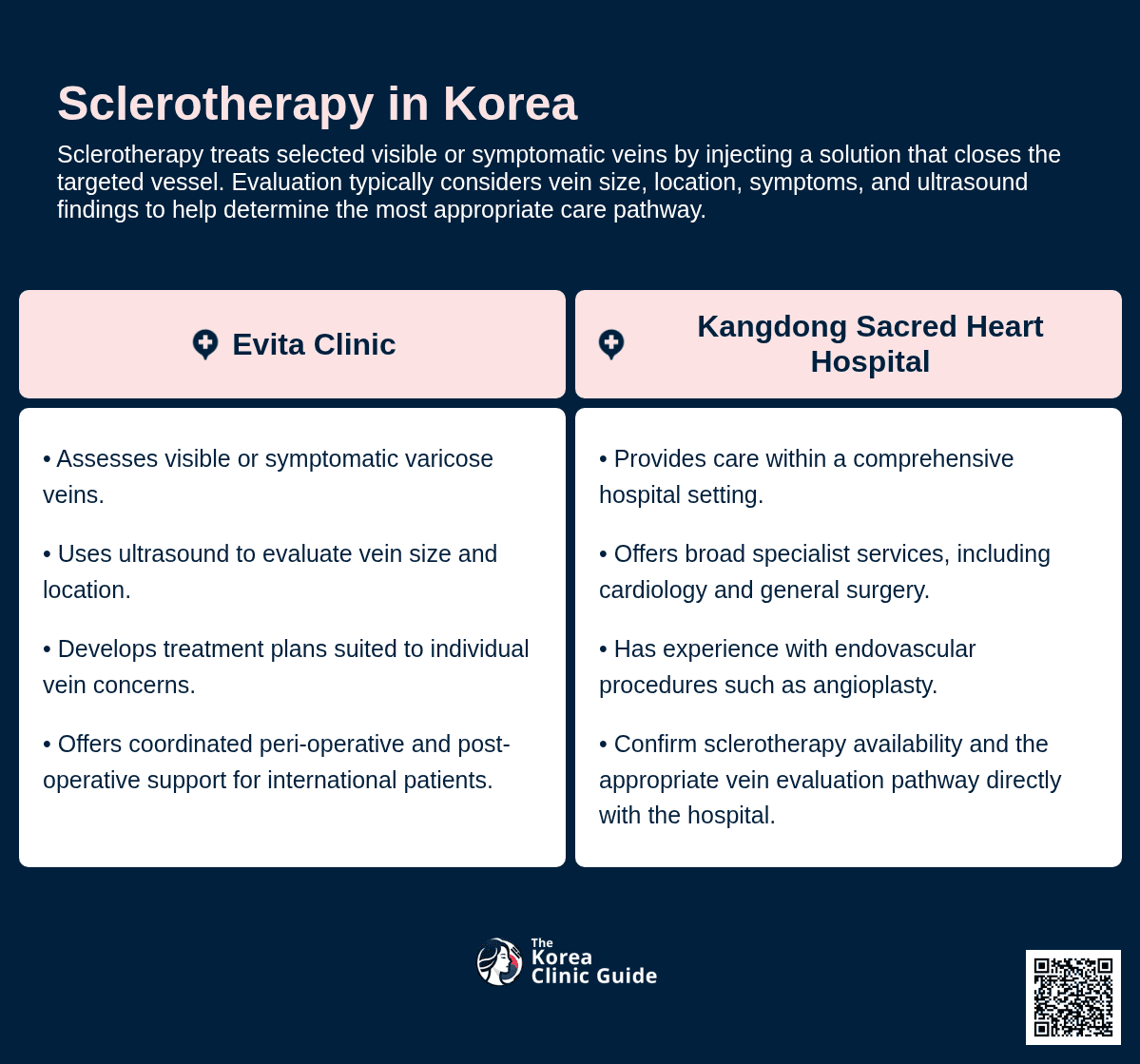
1. Evita Clinic
For vein concerns related to visible or symptomatic varicose veins, Evita Clinic offers treatment planning based on the size and location of your veins, with ultrasound evaluation used to help select an appropriate approach. You can also access coordinated peri-operative and post-operative care designed for international visitors.
- URL: Evita Clinic Website
- Location: 5F, 815, Nonhyun-ro, Gangnam-gu, Seoul, South Korea
- Vein care considerations:
- Varicose vein treatment is intended to address enlarged, visible veins and symptoms such as heaviness or aching.
- Treatment selection is guided by vein size, location, and ultrasound evaluation.
- Additional services: The clinic also provides body contouring, breast surgery, gender-affirming chest surgery, hyperhidrosis treatment, fat grafting, and face contouring.
2. Kangdong Sacred Heart Hospital
You may consider Kangdong Sacred Heart Hospital if you value a hospital setting with a broad range of specialized medical services and endovascular experience, including angioplasty for narrowed or obstructed blood vessels. The supplied information does not specify whether sclerotherapy is offered, so you should confirm procedure availability and the appropriate evaluation pathway directly with the hospital.
- URL: Kangdong Sacred Heart Hospital Website
- Location: Seoul
- Hospital-based services:
- The hospital lists specialized care across general surgery, orthopedics, neurology, cardiology, oncology, urology, gastroenterology, and nephrology.
- Its cardiology services include angioplasty, a minimally invasive endovascular procedure for widening narrowed or obstructed blood vessels.
Varicose Vein Treatment From Start to Finish
- Remote enquiry and consultation — Send a symptom history, photographs only as supplementary information, medication and allergy lists, prior DVT/PE or thrombophilia history, pregnancy status, previous vein-treatment records, and any prior duplex report. English-language or virtual consultation can clarify whether travel is reasonable, but it cannot replace venous mapping.
- In-person vascular evaluation — The clinician examines pulses, skin changes, ulcers, edema, and the distribution of varicose veins. Standing duplex ultrasound maps reflux, obstruction, great and small saphenous veins, accessory veins, tributaries, and perforators; it also helps exclude DVT when clinically indicated.
- Treatment plan and travel clearance — Confirm the target vein or veins, EVLA, RFA, glue, MOCA, foam, phlebectomy, or surgery; anesthesia plan; whether branches will be treated at the same visit; compression; clot prevention; review timing; and a written flight plan. The final decision should account for arterial disease, deep-venous disease, VTE risk, and vein tortuosity.
- Treatment-day preparation — The team marks the target veins with ultrasound, cleans the leg, and applies sterile drapes. Straightforward endovenous treatment usually uses local anesthesia; thermal ablation also uses tumescent anesthetic around the target vein. Sedation or general anesthesia is reserved for selected cases or combined surgery.
- Vein closure or removal — Under ultrasound guidance, the clinician inserts a catheter through a small puncture for EVLA, RFA, cyanoacrylate closure, MOCA, or foam treatment. Microphlebectomy removes selected bulging branches through small incisions. Procedure duration depends on the number of veins, laterality, branch treatment, and anesthesia plan.
- Discharge and first walk — Walk before leaving, then use hotel transport rather than driving. Collect the procedure report naming the device and treated veins, dressings, medication guidance, compression plan, and urgent-contact details.
- Early recovery and review — Walk several times daily and attend any scheduled scan or clinical review before departure. Report worsening pain, swelling, redness, fever, drainage, rash, or breathing symptoms promptly rather than waiting for a virtual appointment.
- Overseas follow-up — Share procedure records with the home clinician and use the agreed remote follow-up route. Reassess remaining symptomatic or visible tributaries at approximately three months rather than assuming persistent branches mean treatment failure.
Alternatives to Varicose Vein Treatment
Non-surgical approaches can control symptoms or treat selected veins with less tissue disruption, but they do not all provide the same durability or suit the same reflux pattern. Surgery remains an option for anatomy that cannot be managed safely with catheter-based treatment, while deferral is appropriate when medical risk or travel timing is unsuitable.
Compression Therapy
- Best role — Graduated compression hosiery can reduce symptoms while intervention is deferred, declined, or unsuitable, including during pregnancy.
- Tradeoff — Compression does not permanently correct venous reflux. Use the stocking strength and schedule prescribed after arterial circulation and skin status are assessed.
Ultrasound-Guided Foam Sclerotherapy
- Best role — Foam can treat residual, recurrent, or tributary veins and some truncal veins when catheter-based thermal treatment is unsuitable.
- Tradeoff — It avoids incisions and tumescent anesthesia but can require staged treatment and has risks including pigmentation, superficial thrombophlebitis, residual veins, and thrombosis.
Ambulatory Phlebectomy
- Best role — Microphlebectomy directly removes prominent surface branches that remain symptomatic or bothersome after truncal reflux is addressed.
- Tradeoff — It involves small incisions and bruising, often with a longer visible recovery than injection-only treatment.
Ligation and Stripping
- Best role — Open surgery is reserved for selected anatomy, recurrent disease, or circumstances where endovenous treatment and foam are unsuitable.
- Tradeoff — It is more invasive and commonly requires more recovery planning than EVLA, RFA, glue, MOCA, or foam.
How Can I Prepare for Varicose Vein Treatment?
- Medical disclosure — Provide every prescription and non-prescription medicine, supplement, and allergy: warfarin, apixaban, rivaroxaban, dabigatran, aspirin, clopidogrel, NSAIDs, diabetes medicines, hormone therapy, herbal products, latex, local anesthetics, and cyanoacrylate adhesive. Also disclose prior DVT/PE, thrombophilia, cancer, ulcers, bleeding, kidney or heart disease, and prior vein procedures.
- Anticoagulant plan — Do not independently stop aspirin, antiplatelet treatment, or anticoagulants. The treating clinician must issue a method-specific plan and decide whether thromboprophylaxis or targeted imaging is needed.
- Fasting and alcohol — Confirm fasting requirements in writing. Local anesthesia alone often has different requirements from sedation or general anesthesia. Avoid alcohol on treatment day and for the period specified when sedatives, opioids, or other impairing medicines are used.
- Leg preparation — Avoid applying heavy lotions to the leg on treatment day, wear loose trousers or shorts and comfortable walking shoes, and follow instructions on shaving or dressings. Bring clinician-specified compression garments rather than choosing stocking strength independently.
- Nicotine and sun — Disclose smoking, vaping, and nicotine replacement use and follow the clinic’s cessation plan. There is no universal ablation-specific sun ban, but protect bruised or healing puncture and incision sites from ultraviolet exposure to limit discoloration.
- Accommodation and transport — Book lodging that supports frequent short walks and avoids long immobile transfers. Arrange hotel transport; a companion is prudent and can be mandatory after sedation, general anesthesia, or extensive bilateral treatment.
- Flight flexibility — Keep return flights flexible until the clinician approves travel. Build the early review and the potential four-week restriction on long-haul flying into the itinerary.
Travel note: Do not self-drive after treatment unless the treating team specifically clears it. A responsible adult or medical escort is particularly important after sedatives or general anesthesia.
Confirm all clinic-specific medication, fasting, compression, escort, and flight requirements with the treating doctor; individualized instructions take precedence over general guidance.
Aftercare Advice
Early movement and rapid action on warning signs are central to safe recovery after varicose-vein treatment.
- Walking and activity — Walk immediately after discharge and take several short walks each day. Avoid prolonged bed rest, long periods sitting in a car or train, heavy lifting, strenuous exercise, prolonged standing, and prolonged driving until the treating clinician clears them.
- Compression and dressings — Wear compression exactly as prescribed; duration differs after thermal ablation, glue, foam, phlebectomy, and combined treatment. Keep dressings clean and dry and do not soak or swim until the clinic approves it.
- Expected effects — Bruising, tenderness, localized tightness, and a palpable firm treated-vein cord are common and can persist for weeks. Use only the analgesia recommended by the treating team.
- Skin protection — Protect bruised and healing puncture or incision sites from sun exposure to reduce persistent discoloration. Follow the clinic’s scar-care directions after phlebectomy or open surgery.
- Urgent symptoms — Seek same-day medical advice for increasing redness or warmth, fever, drainage, rapidly increasing swelling, uncontrolled pain, new weakness or numbness, or widespread rash or hives, especially after cyanoacrylate closure. Seek emergency assessment immediately for chest pain, shortness of breath, coughing blood, fainting, severe calf pain or swelling, or inability to bear weight.
- Follow-up and results — Attend the agreed review or symptom-triggered duplex scan. The treated trunk closes after successful treatment, but visible branches and durable symptom improvement are best reassessed around three months.
Follow the treating doctor’s individualized instructions and contact the clinic promptly when anything appears wrong.
Frequently Asked Questions
Related Blogs
PRP Injection in Korea: Methods, Recovery, Risks, and Travel Planning
PRP facial injection uses platelet-enriched plasma from a small blood sample, prepared by centrifugation and injected into selected facial planes; protocols, results, and repeat schedules vary. International patients can plan 2–3 days for uncomplicated care, arrange 24–72-hour follow-up, follow aftercare guidance, and seek urgent assessment for eye or central-face symptoms.
Updated: Oct 4, 2026
NK Cell Therapy in Korea: Eligibility, Treatment Methods, Risks, and Travel Planning
NK-cell therapy is an investigational, cancer-specific treatment involving eligibility testing, possible conditioning chemotherapy, IV cell infusion, adjunct medicines, and monitoring. The article explains candidate criteria, Korea regulatory documentation, travel planning, aftercare, and coordination with home and treating oncologists.
Updated: Sep 28, 2026
Discovering the True Cost of Keloid Ear Surgery: Korea vs. Global Alternatives
Discover the cost of keloid ear surgery in Korea, where advanced medical techniques combine with affordability to offer effective treatment options. Learn about factors influencing prices and why many choose Korea for their cosmetic and reconstructive surgery needs.
Updated: Sep 27, 2026
Comparing Costs: Why Korea Is a Top Destination for Foreign Body Removal vs Global Alternatives
Discover the costs and procedures involved in Foreign Body Removal in Korea, a popular destination for affordable and high-quality medical care. Learn about the factors influencing prices and how Korea's healthcare system ensures safe and efficient treatments for overseas patients.
Updated: Sep 26, 2026