
Medical Tourism Blog
Filler Dissolver in Korea: Hyaluronidase Methods, Recovery, Risks, and Travel Planning
Table of contents
- Filler Dissolver at a Glance
- What Is Filler Dissolver?
- Who Is a Good Candidate for Filler Dissolver?
- How Is Filler Dissolver Performed?
- Why Visit Korea for Filler Dissolver?
- Key Information for International Patients
- Which Are the Best Clinics in Korea for Hyaluronidase?
- Filler Dissolver From Start to Finish
- Alternatives to Filler Dissolver
- How Can I Prepare for Filler Dissolver?
- Aftercare Advice
Considering treatment in Korea? Everything you need to know e.g. — how to avoid scams, visas, interpreters, recovery tips — in our Medical Tourism Master Guide. Plan with confidence in minutes, not weeks!
Last updated: September 2026
Filler Dissolver at a Glance
- What it does — Filler dissolver uses injected hyaluronidase to break down hyaluronic-acid (HA) filler, usually to correct overfilling, migration, asymmetry, superficial discoloration, or localized lumps.
- Only works on HA filler — Hyaluronidase is not a universal filler remover: it does not reliably dissolve calcium hydroxylapatite, poly-L-lactic acid, PMMA, silicone, fat grafts, threads, or most permanent fillers.
- Results take about 2 weeks — The enzyme starts working promptly and change may be visible the same day or within days, but elective cosmetic results are best reassessed after roughly 2 weeks, once swelling has settled.
- Downtime is usually brief — Redness, tenderness, itching, swelling, and temporary unevenness commonly last 24–72 hours; bruising may remain visible for 1–2 weeks.
- Staged treatment may be needed — Older, deep, migrated, highly cross-linked, or repeatedly injected HA filler may not respond fully in one session, so conservative targeted treatment can reduce the risk of unwanted hollowing.
- Emergency symptoms need immediate care — Severe or worsening pain, blanching, cool skin, net-like purple discoloration, delayed capillary refill, visual changes, or neurologic symptoms after filler may signal vascular compromise and are medical emergencies.
- Korea travel planning — For uncomplicated elective treatment in Korea, allow at least 2–3 days; a 7–14-day stay better accommodates bruising and reassessment. Ask whether the clinic offers high-frequency ultrasound, complication care, after-hours contact, and an English treatment record.
What Is Filler Dissolver?
Filler dissolver is an injection of hyaluronidase, an enzyme used to break down hyaluronic-acid filler. It helps correct unwanted filler-related fullness, migration, asymmetry, lumps, or superficial discoloration while allowing targeted volume reduction. It is a minimally invasive injectable treatment, not surgery.
Who Is a Good Candidate for Filler Dissolver?
- Documented or suspected HA filler — Adults with hyaluronic-acid (HA) filler and persistent overcorrection, asymmetry, migration, superficial blue-gray discoloration, or a palpable localized lump can be assessed for targeted hyaluronidase.
- Established post-filler concern — Good candidates have allowed normal early filler swelling to settle and want correction of a specific contour problem rather than immediate removal based on the first few days after filler placement.
- Staged correction goal — Patients seeking a small reduction in lip projection, under-eye fullness, migrated filler, or a focal irregularity often benefit from a conservative plan that preserves useful volume where possible.
- Urgent symptoms after HA filler — Severe pain, blanching, cool skin, net-like purple discoloration, delayed capillary refill, vision changes, or neurologic symptoms require emergency assessment for possible vascular compromise, not a routine aesthetic appointment.
Elective treatment is unsuitable when the injected material is not known to be HA, because hyaluronidase does not reliably remove calcium hydroxylapatite, poly-L-lactic acid, PMMA, silicone, fat graft, threads, or permanent filler. Defer treatment for active infection, cellulitis, open skin, herpes near the injection area, or an unexplained inflamed or fluctuant nodule until the cause is established. Known hyaluronidase hypersensitivity or previous anaphylaxis is a major contraindication to elective treatment; serious bee or wasp-sting allergy also requires careful allergy-risk assessment because venom can contain hyaluronidase. Pregnancy and breastfeeding lack adequate elective-treatment data, and non-urgent treatment is generally deferred. The clinician must determine whether the issue is retained HA, edema, scar tissue, normal anatomy, inflammation, or infection before injecting.
How Is Filler Dissolver Performed?
Filler dissolver is not one fixed treatment. The clinically important distinction is why hyaluronidase is being used and how precisely the suspected HA deposit can be located.
- Elective targeted dissolution — The clinician places a conservative dose into or close to an identified HA deposit to soften a lump, reduce excess projection, improve migration, or correct asymmetry. Staging helps limit unwanted hollowing and avoids treating the entire area when only one deposit is problematic.
- Ultrasound-assisted dissolution — High-frequency ultrasound can help locate deep, migrated, recurrent, periorbital, or diagnostically uncertain filler and map nearby vessels before injection. Evidence for ultrasound-guided vascular-complication treatment is encouraging, but a systematic review of small observational cohorts does not prove complete elective filler clearance or superior cosmetic outcomes in every case.
- Urgent vascular-compromise protocol — Suspected HA-related ischemia is treated urgently, with repeated same-day reassessment rather than a single cosmetic-dose approach. Earlier treatment was associated with better reported outcomes in a review of case reports and case series, but controlled trials have not established one universal protocol.
- Delayed inflammatory-nodule management — Hyaluronidase can form part of treatment for selected HA-associated delayed reactions. A fluctuant nodule, fever, pus, or spreading redness can indicate infection and instead requires diagnostic assessment, possible culture or drainage, and medical treatment.
Why Visit Korea for Filler Dissolver?
Korea receives a substantial number of international medical visitors, and foreign patients can seek care through registered medical institutions. For filler dissolution, however, country-level outcome superiority has not been established. Choose a treating team based on its ability to identify the filler, use imaging when appropriate, manage anaphylaxis or vascular concerns, and provide continuity after departure.
- Registered-provider framework — The Medical Korea registered-system directory helps international patients identify institutions participating in the national foreign-patient registration framework. Registration alone does not demonstrate filler-complication expertise.
- International medical-care infrastructure — Seoul reported more than 1 million international medical tourists in 2024, supporting the availability of services designed for overseas visitors. Confirm English communication, after-hours contact, and the exact physician responsible for treatment rather than assuming these services are universal.
- Imaging-led assessment option — For uncertain, deep, migrated, or under-eye filler, ask whether high-frequency ultrasound is available and whether the physician is experienced in interpreting it. Ultrasound can improve anatomical targeting but remains operator-dependent and cannot confirm that all filler has been removed.
- Documentation for onward care — Request an English procedure record with the suspected diagnosis, hyaluronidase brand, total units, dilution, injection sites, use of ultrasound, adverse events, and direct clinic contact. This is especially important when further care will occur at home.
Key Information for International Patients
- Minimum stay — Plan at least 2–3 days for an uncomplicated elective HA-filler dissolution: consultation and treatment, with an early in-person review if the clinician considers it necessary. A 7–14-day stay is more cautious because it permits bruising and swelling to settle and allows planned reassessment.
- Repeat visits — The enzyme starts acting promptly, but elective aesthetic results are commonly judged after at least 2 weeks, once swelling has settled. Older, deeply placed, highly cross-linked, migrated, or repeatedly injected HA filler can require staged treatment rather than one session.
- Flight timing — No evidence-based universal interval exists for long-haul flying after hyaluronidase. Do not schedule same-day international departure with significant swelling, a suspected allergic reaction, infection, uncertain diagnosis, treatment in the nose or periocular area, or any vascular concern.
- Activity and itinerary — Redness, tenderness, itching, swelling, and unevenness commonly last 24–72 hours; bruising can remain visible for 1–2 weeks. Keep the first 48 hours low exertion and avoid scheduling major photographs, events, or further facial procedures.
- Remote follow-up — Arrange a video check and send standardized photographs only through the clinic’s secure channel. Identify a clinician at home before travel when multiple sessions, infection evaluation, substantial edema, or complication care is anticipated.
Travel note: For vascular compromise, remain under the treating team’s direction and defer travel until tissue perfusion is stable and the clinician considers follow-up safe. New visual symptoms are an emergency, not a problem to monitor from abroad.
Which Are the Best Clinics in Korea for Hyaluronidase?
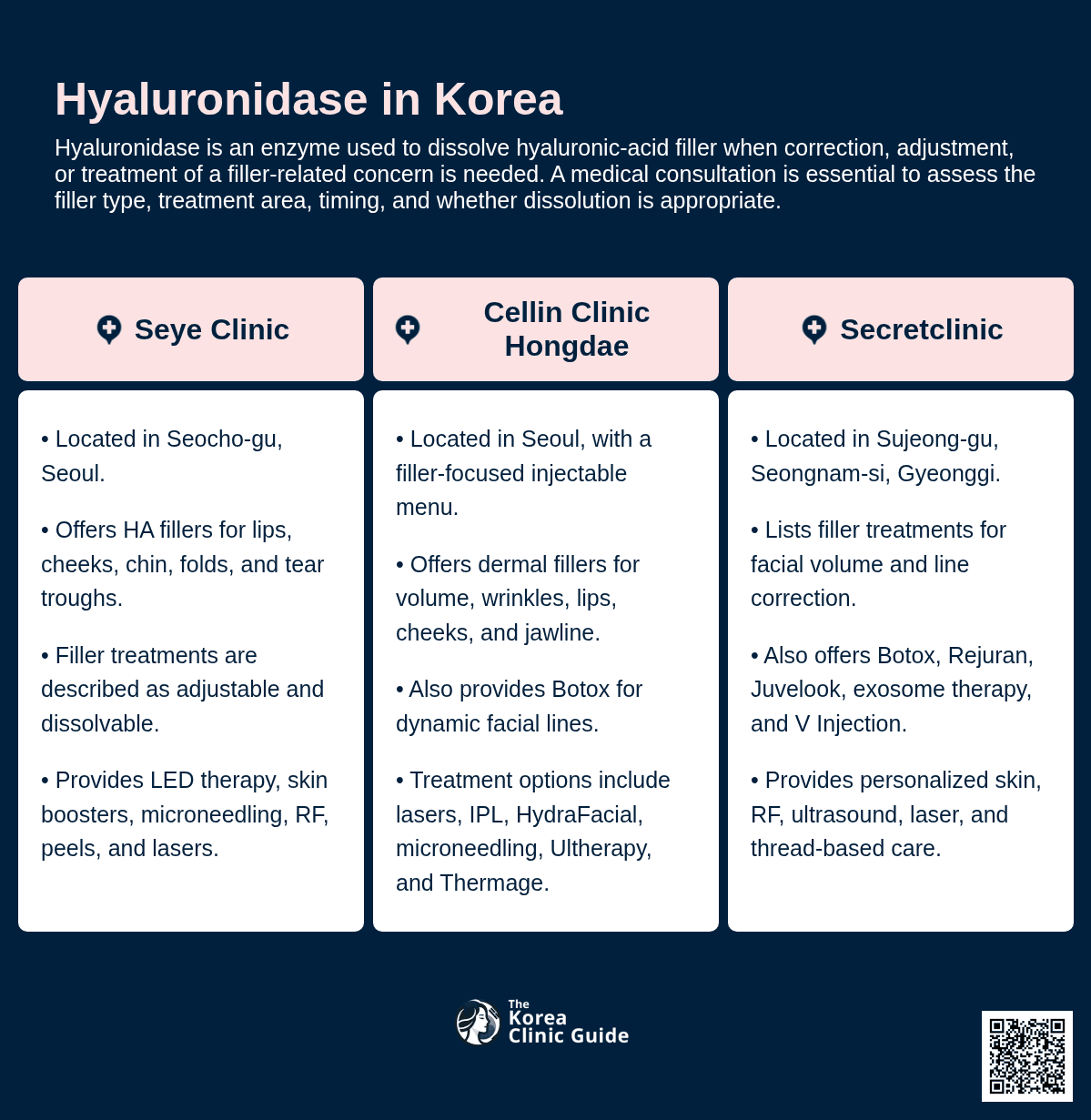
Listed below are some of the best clinics in Korea for hyaluronidase.
1. seye clinic
You may consider Seye Clinic if you are seeking assessment after hyaluronic-acid filler, because its stated injectable offering includes HA dermal fillers described as adjustable and dissolvable. The clinic also provides filler treatments for areas such as the lips, cheeks, chin, folds, and tear troughs, which may be relevant when discussing a filler-related concern and whether hyaluronidase is appropriate.
- URL: seye clinic Website
- Location: Seocho-gu, Seoul
- Relevant injectable care:
- Offers hyaluronic-acid dermal fillers for facial volume and contouring, including lips, cheeks, chin, and facial folds.
- Lists lip filler and tear-trough filler services; the tear-trough treatment description notes cannula techniques to help reduce bruising.
- Provides botulinum toxin treatments alongside filler services.
- Related skin and recovery options:
- Offers LED light therapy described as calming redness and supporting post-procedure healing.
- Provides skin boosters, microneedling, RF microneedling, chemical peels, and laser-based treatments for texture, pigment, redness, and acne-related concerns.
2. Cellin Clinic Hongdae
You can expect a clinic whose listed injectable services include dermal fillers for restoring volume and smoothing wrinkles, alongside Botox and a broad range of laser and skin-rejuvenation treatments. Although hyaluronidase is not specifically listed, the filler-focused service menu may make Cellin Clinic Hongdae a reasonable place to discuss a filler-related concern and whether this treatment is suitable for you.
- URL: Cellin Clinic Hongdae Website
- Location: Seoul
- Injectable services:
- Lists dermal fillers for volume restoration, wrinkle smoothing, and enhancement of the lips, cheeks, and jawline.
- Also offers Botox for dynamic facial lines.
- Skin treatment options:
- Offers laser toning, pico laser, IPL, HydraFacial, microneedling, and fractional laser treatments.
- Lists Ultherapy and Thermage for non-surgical skin tightening.
3. Secretclinic
You can expect a personalized consultation approach at Secretclinic, which lists filler treatments among its injectable services and describes tailored care for skin and body concerns. Hyaluronidase is not specifically named in the available information, so you should discuss your existing filler, treatment area, and goals to determine whether it is an appropriate option for you.
- URL: Secretclinic Website
- Location: Sujeong-gu, Seongnam-si, Gyeonggi
- Relevant injectable services:
- Lists filler treatments for restoring volume and smoothing facial lines.
- Offers Botox, Rejuran, Juvelook, exosome therapy, and facial fat-dissolving V Injection.
- Personalized skin care:
- Lists skin-barrier care, exfoliation and sebum care, acne treatment, and elasticity care.
- Offers RF, ultrasound, laser, and thread-based treatments for skin tightening and lifting.
Filler Dissolver From Start to Finish
- Remote inquiry and record review — Send clear photographs, original filler product cards or injector records if available, dates, volumes, anatomical sites, prior filler and dissolver history, allergies, medicines, supplements, and any history of delayed nodules, dental work, or facial procedures. Confirm whether English or virtual consultation is available.
- Pre-travel clinical plan — Ask whether the clinic believes the injected product is HA, whether ultrasound or an allergy-risk assessment is needed, who manages emergencies, and whether an early in-person review can be scheduled before departure. Keep flights flexible until the diagnosis and treatment response are clear.
- In-person assessment — The physician examines contour, skin temperature and color, tenderness, capillary refill, mobility of nodules, and signs of inflammation. Standardized photographs document the baseline; ultrasound can be used when filler depth, location, migration, or vessel proximity is uncertain.
- Consent and allergy discussion — The clinician explains incomplete response, loss of desired filler, hollowing, asymmetry, infection, and allergic reaction. Some elective protocols use a small intradermal test dose, but testing does not reliably exclude delayed reactions and must not delay emergency care for suspected vascular compromise.
- Injection treatment — After cleansing the skin, topical anesthetic can be used. The physician reconstitutes hyaluronidase and injects it with a needle or cannula in the intended tissue plane, close to the HA deposit; ultrasound guidance can assist targeted placement. Appointment time is usually short, but duration depends on the area, diagnostic uncertainty, and whether urgent monitoring is needed.
- Immediate observation and discharge — Uncomplicated elective cases usually leave the clinic the same day with written aftercare and an emergency contact. Urgent cases require repeated perfusion assessment and continued treatment according to the clinician’s protocol.
- Early review and reassessment — Contact the clinic promptly for increasing swelling, hives, worsening pain, skin-color change, or other concerns. Reassess elective contour after about 2 weeks rather than judging the final result during early swelling or bruising.
- Remote follow-up and future filler planning — Obtain an English treatment summary before leaving Korea. When future HA filler is desired, a minimum 2-week interval after dissolution is commonly used for more predictable reassessment; longer is appropriate after substantial swelling, infection, or complications.
Alternatives to Filler Dissolver
The right alternative depends on the material injected and the actual cause of the contour concern. Hyaluronidase is the direct option for confirmed or strongly suspected HA filler, while non-HA materials often need observation, imaging, medical treatment, or surgery rather than an enzyme injection.
Observation
- Best suited to — Recent filler placement where swelling has not resolved, mild dissatisfaction, or a suspected temporary edema component.
- Tradeoff — Avoids injection risks but does not rapidly correct true HA overfilling, migration, or a persistent deposit.
Diagnostic imaging and medical treatment
- Best suited to — Uncertain filler identity, deep or migrated material, delayed inflammatory nodules, suspected infection, or unexplained persistent swelling.
- Tradeoff — Ultrasound can guide diagnosis and targeting; infection can require culture-directed treatment, drainage, or antibiotics rather than dissolving. It adds time and does not guarantee identification of every material.
Corrective HA filler
- Best suited to — A verified contour deficit after swelling has settled and after migration, infection, and vascular injury have been excluded. Learn more about facial filler, lip fillers, or under-eye filler.
- Tradeoff — Can restore a true hollow or asymmetry but is not a substitute for diagnosing excess filler or migration, and adds filler to an already uncertain situation.
Surgical or foreign-body management
- Best suited to — Selected complications from permanent or non-HA filler, silicone, PMMA, fat graft, or other material that hyaluronidase cannot dissolve. See foreign-body removal.
- Tradeoff — Can address material that enzyme treatment cannot, but surgery has more downtime, scarring risk, and anatomical limitations; complete removal is not always possible.
How Can I Prepare for Filler Dissolver?
- Provide complete records — Send the filler brand, product card, date, volume, injection sites, injector records, and previous photographs when available. Disclose every prior filler and dissolver session, including treatments performed years earlier or abroad.
- Discuss medicines before changing them — Tell the clinician about aspirin, ibuprofen, naproxen, warfarin, apixaban, rivaroxaban, clopidogrel, fish oil/omega-3, vitamin E, ginkgo, garlic, ginseng, and St John’s wort. Do not stop prescribed anticoagulants or antiplatelet medicines solely for a cosmetic procedure without approval from the prescribing clinician.
- Declare allergy and medical history — Report prior hyaluronidase exposure, anaphylaxis, serious bee or wasp-sting allergy, autoimmune or inflammatory illness, herpes history, prior delayed nodules, infection, dental work, and facial procedures.
- Avoid alcohol and skin irritation — Avoid alcohol for at least 24 hours before treatment if directed, and arrive without makeup over the treatment area. Do not book aggressive facials, peeling, laser procedures, or facial massage immediately around the appointment.
- Fasting and transport — Fasting is usually unnecessary because elective treatment generally uses local measures rather than IV sedation or general anesthesia. Follow clinic fasting instructions if sedation is planned; arrange low-exertion local transport afterward and bring a companion when sedated, anxious, or being treated for a complication.
- Plan for review — Stay near the clinic, keep a working phone available, and keep flights and major events flexible. Avoid smoking or vaping where possible; nicotine is especially inappropriate when there is any vascular concern.
Travel note: Ask before booking whether high-frequency ultrasound, hyaluronidase, anaphylaxis-rescue medication, after-hours review, and an English procedure report are available.
The treating doctor’s individualized instructions take precedence; confirm the clinic’s medication, fasting, and travel requirements before treatment.
Aftercare Advice
Protect the treated area and remain reachable for early review; do not mistake worsening pain, color change, or systemic allergy symptoms for routine swelling.
- Manage early swelling — Use cool, not ice-cold, compresses only if the clinician advises. Redness, tenderness, swelling, itching, bruising, and temporary unevenness commonly improve within 24–72 hours, although bruising can last 1–2 weeks.
- Avoid pressure and heat — Do not massage, press, use gua sha, facial devices, or heat unless specifically instructed. Avoid strenuous exercise, saunas, steam rooms, hot yoga, heavy alcohol intake, and excessive sun or heat for about 24–48 hours or until redness and swelling improve.
- Use gentle skincare — Cleanse gently and apply bland moisturizer. Once injection points have closed, use broad-spectrum SPF 50 sunscreen; avoid retinoids, exfoliating acids, scrubs, and aggressive facials until the skin settles.
- Judge the result at the right time — Visible change can begin the same day or over several days, but wait about 2 weeks for elective aesthetic assessment. Do not pursue repeat treatment without a clear anatomical target, as excessive dissolution can create hollowing or remove desired HA filler.
- Know urgent warning signs — Seek urgent clinical assessment for rapidly increasing swelling, hives, wheeze, throat tightness, dizziness, fainting, fever, spreading redness, pus, or severe/worsening pain. Call emergency services immediately for visual changes, ocular pain, ptosis, neurologic symptoms, blanching, livedo, or cool painful skin.
Follow the treating doctor’s instructions over general guidance and contact the clinic promptly when anything appears wrong.
Frequently Asked Questions
Related Blogs
Comparing Global Costs of Pico Fraxel: Why Korea is a Top Choice for Skin Rejuvenation Without Compromise
Discover the affordability of Pico Fraxel laser treatments in Korea, where cutting-edge technology meets competitive pricing. Explore why many are choosing Korea for their skincare journey and how it compares to global costs.
Updated: Oct 21, 2026

Optimize Your Wellness: See Why Vitamin Injections in Korea Offer Value Beyond Costs Compared to the USA & More
Discover the latest trends in the cost of vitamin injections in Korea, exploring factors affecting pricing and popular clinics. Learn how these wellness treatments can boost your energy and overall health.
Updated: Oct 21, 2026
Laser Tattoo Removal Costs: Is Korea Your Best Option Compared to the USA, Turkey, and Beyond?
Discover the factors influencing the cost of laser tattoo removal in Korea, from technology and expertise to session frequency. Explore why Korea is becoming a popular destination for this effective and advanced cosmetic procedure.
Updated: Oct 21, 2026
Unlock Radiant Skin: Comprehensive Cost Analysis of Steroid Injections for Scars in Korea vs USA, Turkey & More
Explore the cost of steroid injections for scars in Korea, a popular cosmetic procedure aimed at minimizing the appearance of scar tissue. This article breaks down the pricing, factors influencing cost, and potential savings compared to other countries.
Updated: Oct 21, 2026
Clinics offering Filler Dissolver

Haru Clinic Korea | Fully-Customized Full-Face Non-Surgical Rejuvenation With Threads, Botox & Fillers
Sinsa

B.V Clinic Korea: Advanced Aesthetic Treatments for Natural Beauty Enhancement & Rejuvenation
Sinnonhyeon Station

Beauty Blossom Clinic Korea: Advanced Non-Surgical Skin, Anti-Aging & Aesthetic Treatments in Hongdae
Hongdae

Secret Clinic: Unveiling Advanced Skin and Body Treatments in Seongnam, Korea
Sinnonhyeon Station