
Medical Tourism Blog
Titanum Lifting in Korea: Methods, Evidence, Recovery, and Travel Planning

Table of contents
- Titanum Lifting at a Glance
- What Is Titanum Lifting?
- Who Is a Good Candidate for Titanum Lifting?
- How Is Titanum Lifting Performed?
- Why Visit Korea for Titanum Lifting?
- Key Information for International Patients
- Which Are the Best Clinics in Korea for Titanum Lifting?
- Titanum Lifting From Start to Finish
- Alternatives to Titanum Lifting
- How Can I Prepare for Titanum Lifting?
- Aftercare Advice
Considering treatment in Korea? Everything you need to know e.g. — how to avoid scams, visas, interpreters, recovery tips — in our Medical Tourism Master Guide. Plan with confidence in minutes, not weeks!
Last updated: September 2026
Titanum Lifting at a Glance
- What it is — Titanium Lifting is a clinic-designed, off-label facial protocol using the Alma Soprano Titanium Trio’s simultaneous 755, 810, and 1064 nm diode-laser wavelengths; it is not a standardized non-surgical facelift.
- Best candidates — It may suit adults seeking subtle-to-moderate improvement in early laxity, mild jawline softness, texture, or brightness—not correction of excess skin, substantial jowls, major neck laxity, or significant tissue descent.
- Evidence limitation — The device’s FDA-cleared labeling does not include facial lifting, collagen stimulation, contouring, or brightening, and controlled studies have not established the protocol’s optimal settings, durability, or complication rates.
- Recovery — Same-day discharge is typical, with warmth, redness, tenderness, or mild swelling usually settling within hours to a few days; avoid heat, strenuous exercise, sauna, steam, and direct sun for about 24–72 hours while reactive.
- Results and repeats — Any visible refinement is variable, and a delayed 2–3 month collagen-remodeling timeline has not been proven for this protocol; reassess at 8–12 weeks before booking another session because no evidence-based maintenance schedule exists.
- Korea travel planning — Korea is notable for widespread marketing of Titanium Lifting as a named protocol, not proven superior outcomes; allow 1 day minimum or preferably 2–3 days, and leave with the exact device, treatment details, aftercare instructions, and an urgent English-language contact route.
- Key risk — Thermal injury and pigment changes are important concerns, particularly with tanning, melasma, or prior post-inflammatory hyperpigmentation; treatment near brows, hairline, sideburns, beard, or upper lip also needs planning because the underlying device has hair-reduction indications.
What Is Titanum Lifting?
Titanum Lifting, often marketed as Titanium Lifting, is a clinic-designed facial diode-laser treatment using three wavelengths to target skin rejuvenation. It aims to provide subtle improvement in early facial laxity, mild jawline softness, texture, and overall radiance, rather than the structural correction of a facelift. It is a non-surgical, non-ablative laser procedure.
Who Is a Good Candidate for Titanum Lifting?
- Early laxity and skin-quality concerns — Adults seeking a subtle-to-moderate refinement of mild jawline softness, early lower-face laxity, texture, or a brighter-looking complexion.
- Realistic treatment goals — Candidates understand that this is not a non-surgical facelift and cannot remove excess skin, reposition significantly descended tissues, or reliably correct substantial jowls or neck laxity.
- Pigment-aware patients — A suitable candidate can provide a history of tanning, melasma, post-inflammatory hyperpigmentation, vitiligo, prior laser reactions, cold sores, scars, and recent aesthetic treatments.
- Hair-bearing-area planning — People treating near the brows, hairline, sideburns, beard, or upper lip need a specific plan to avoid unwanted hair effects, because the underlying Trio device also has hair-reduction indications in its cleared labeling.
Do not proceed over active infection, cold sores, open wounds, dermatitis, sunburn, or markedly irritated skin. Postpone this elective protocol during pregnancy or breastfeeding because Titanium Lifting-specific safety evidence is lacking. Photosensitizing medicines, poorly controlled diabetes, immunosuppression, impaired healing, connective-tissue disease, melasma or PIH history, keloid tendency, and prior laser complications require individualized assessment; do not stop prescribed medicine without the prescribing clinician’s advice. Cosmetic laser treatment is inappropriate for an undiagnosed or changing pigmented lesion, and marked skin excess, substantial fat, or advanced tissue descent calls for a different treatment strategy.
How Is Titanum Lifting Performed?
Titanum Lifting is generally marketed as Titanium or Soprano Titanium Lifting. It is a provider-designed, off-label facial protocol using the Alma Soprano Titanium Trio applicator’s simultaneous 755 nm, 810 nm, and 1064 nm diode wavelengths, not a universally standardized lifting procedure.
- SHR / in-motion delivery — The handpiece moves continuously over a broader treatment area with repeated pulses. Manufacturer/distributor material describes 10 Hz delivery and associates it with tightening and brightening; its illustrative diagram presents a depth of roughly 3–4 mm.
- STACK / stamping delivery — The handpiece is placed at selected points for repeated delivery. The same material describes 2–5 Hz delivery, associates it with lifting and contouring, and illustrates delivery beyond 6 mm.
- Area-based customization — Clinics can combine moving and stamping passes across the cheeks, lower face, jawline, submental area, forehead, or neck according to anatomy and goals.
- Parameters require disclosure — Fluence, pulse duration, pass count, total energy, cooling, and the SHR-to-STACK ratio are clinician-selected. No independent evidence establishes optimal facial-lifting settings, treatment depths, or maintenance intervals for this branded protocol.
The mode descriptions and illustrative depths come from manufacturer/distributor material, not controlled facial-outcome studies. The device’s FDA-cleared labeling does not list facial lifting, collagen induction, contouring, pore reduction, brightening, or facial fat reduction as indications.
Why Visit Korea for Titanum Lifting?
Korea is a practical destination because Titanium Lifting is actively marketed there as a named aesthetic protocol. That availability does not show that treatment in Korea delivers better or safer outcomes than comparable care elsewhere. Selection, pigment-risk assessment, eye protection, conservative settings, and reachable follow-up matter more than the country or marketing name.
- Named-protocol availability — Korean clinics commonly offer the triple-wavelength treatment under Titanium Lifting branding, reflecting local adoption of the protocol rather than a separate regulator-validated technology.
- Identifiable platform — Ask whether the clinic uses the Alma Soprano Titanium Trio applicator, which combines 755 nm, 810 nm, and 1064 nm wavelengths, rather than relying on the treatment name alone.
- Transparent evidence limitation — The available FDA documentation describes the simultaneous triple-wavelength system in a hair-removal study, not a facial-lifting trial. It cannot establish facial tightening, collagen remodeling, contouring, durability, or complication rates for Titanium Lifting.
- Pre-treatment documentation — International patients benefit from obtaining the exact device name, modes, treated areas, operator credentials, and written urgent-contact route before treatment and before leaving Korea.
Key Information for International Patients
- Minimum stay — Allow 1 day for an uncomplicated laser-only session after in-person assessment. Plan 2–3 days when possible so you remain nearby through the next day if swelling, pain, blistering, or pigment change needs review.
- Repeat visits — No evidence-based repeat or maintenance schedule exists for this branded facial protocol. Reassess at about 8–12 weeks before committing to another session or a package.
- Flights — There is no established flight restriction after an uncomplicated external laser session. Delay departure and request review if pain escalates, swelling increases, blisters develop, or the skin becomes gray, white, very dark, or crusted.
- Itinerary impact — No inpatient stay, fasting, general anesthesia, or compulsory companion is normally required. Keep the first 24–72 hours free of sauna, steam rooms, hot yoga, vigorous exercise, direct sun, and activities that leave the face hot or flushed.
- Remote follow-up — Arrange an English-language contact channel, send standardized photographs if requested, and retain a written treatment record for a clinician at home.
Travel note: If the clinic gives sedating medication for anxiety or combination treatment, arrange an adult escort and do not drive, navigate travel alone, or fly while impaired.
Which Are the Best Clinics in Korea for Titanum Lifting?
Listed below are some of the best clinics in Korea for titanum lifting.
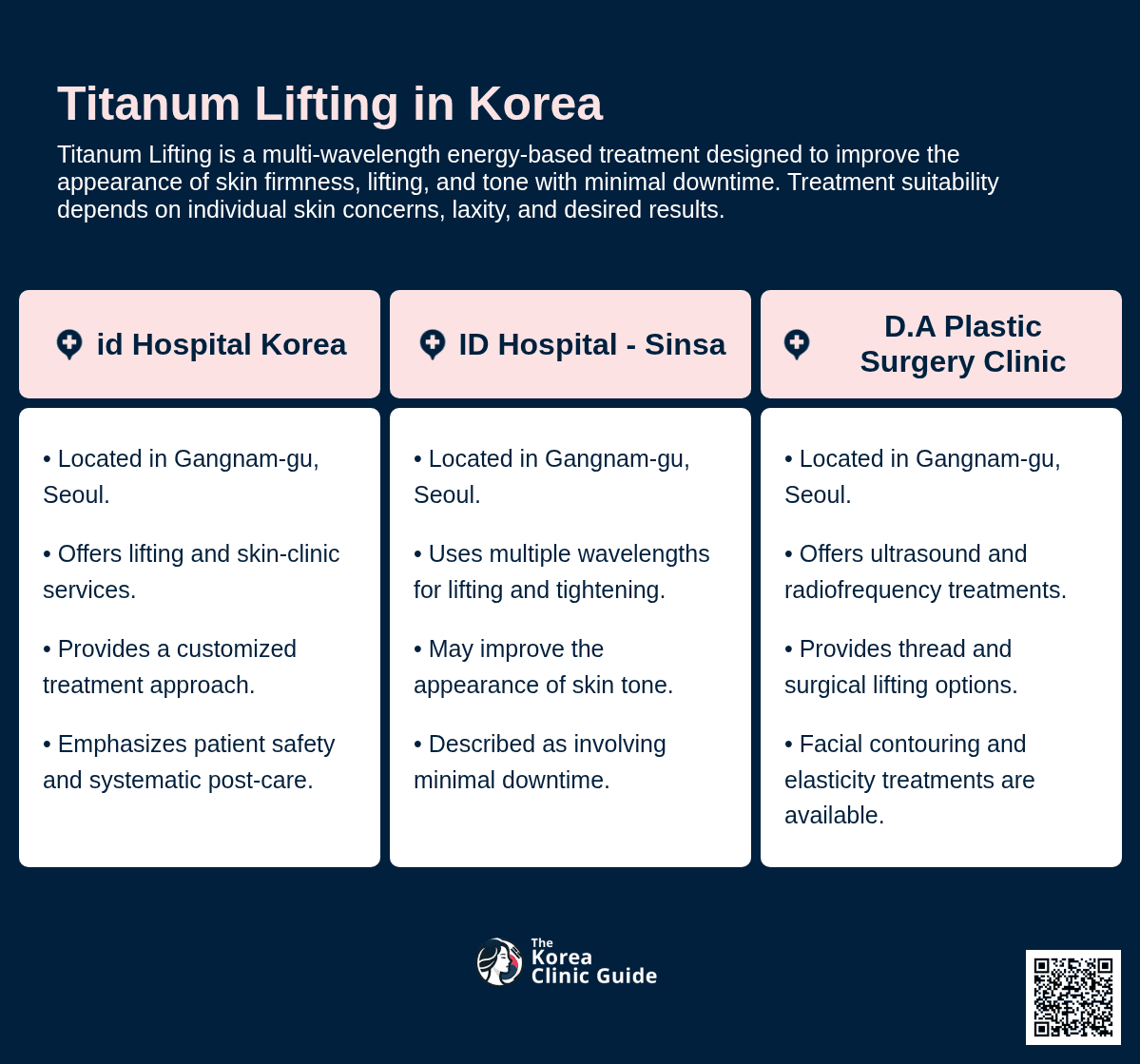
1. id Hospital Korea
At id Hospital Korea, you can discuss Titanum Lifting within a practice that includes lifting and skin-clinic services alongside facial procedures. The clinic describes a customized treatment approach, with patient safety and systematic post-treatment care as stated priorities.
- URL: id Hospital Korea Website
- Location: Gangnam-gu, Seoul
- Related services:
- Lifting and skin-clinic care are listed among the available treatment areas.
- The broader facial-service lineup includes facial contouring, eye and nose surgery, and petit plastic surgery.
- Care approach: The clinic states that treatment is customized and includes systematic post-care.
2. ID Hospital - Sinsa
At ID Hospital - Sinsa, Titanium is presented as a multi-wavelength energy-based treatment intended to address lifting, tightening, and skin-tone improvement in the same session. You may consider it if your goals include firmer-looking, more radiant skin with minimal downtime, while discussing whether its energy-based approach fits your concerns.
- URL: ID Hospital - Sinsa Website
- Location: Gangnam-gu, Seoul
- Titanium treatment:
- Uses multiple wavelengths of energy for lifting, tightening, and skin-tone improvement.
- The clinic describes minimal downtime.
- Other non-surgical options:
- Ultherapy and Eye Ultherapy use focused ultrasound for lifting and collagen stimulation.
- Thermage and Eye Thermage use radiofrequency for skin tightening and elasticity.
- Potenza combines RF microneedling with customizable treatment depths for texture, pores, acne scars, and elasticity.
- ONDA uses Coolwaves technology for localized-fat treatment and skin tightening.
- Complementary skin care:
- Rejuran Healer and Rejuran Eye are listed for skin texture, fine lines, and elasticity.
- Juvelook is offered for texture, fine lines, and hydration.
- Pico Toning is available for pigmentation and a more even skin tone.
3. D.A Plastic Surgery Clinic
D.A Plastic Surgery Clinic may be relevant to your lifting goals because it offers both surgical and non-surgical approaches for skin laxity and facial contour concerns, although the provided information does not specifically list Titanum Lifting. You can explore alternatives such as ultrasound or radiofrequency skin treatments, thread lifting, or surgical lifting based on the degree of sagging and the type of result you want.
- URL: D.A Plastic Surgery Clinic Website
- Location: Gangnam-gu, Seoul
- Non-surgical lifting options:
- Ulthera Tuner uses ultrasound to lift and tighten the face, neck, and décolletage while stimulating collagen production.
- Thermage FLX uses radiofrequency energy to smooth, tighten, and contour the skin.
- Thread lifting uses temporary sutures to create a subtle lift.
- Surgical lifting options:
- Absolute Lifting is described as a facelift procedure for sagging facial and neck skin.
- Minimal Incision Lifting targets specific facial areas through smaller incisions.
- Elasticum Lifting uses elastic threads to lift and support sagging skin.
- Facial Contouring Lifting combines lifting and contouring techniques.
- Related considerations:
- Skin Elasticity Treatment is listed for concerns about laxity and restoring firmness.
- Facial contouring procedures are available if you are also considering changes to jawline, cheekbone, or chin balance.
Titanum Lifting From Start to Finish
- Remote inquiry and screening — Send makeup-free photographs and disclose medical conditions, allergies, medication and supplement use, tanning, pigment history, cold sores, prior laser reactions, and recent fillers, threads, botulinum toxin, peels, microneedling, RF, HIFU, lasers, or surgery. Confirm English consultation availability and ask for the exact device and planned facial areas.
- In-person assessment — The treating clinician examines skin tone, active inflammation, lesions, facial fat distribution, laxity, hair-bearing zones, and the actual cause of the concern. Laxity, volume loss, fat, pigmentation, rosacea, acne, scars, and suspicious lesions require different management.
- Plan and consent — Discuss the off-label status of the facial protocol, modest and variable expected change, alternatives, pigment risk, unwanted facial hair reduction, and the lack of validated settings or a proven collagen-remodeling timeline. Ask whether a test area or modified settings are appropriate when PIH, melasma, or prior laser reactions are relevant.
- Skin preparation — Staff cleanse the face and can mark treatment zones. Routine blood tests and fasting are not generally required for an uncomplicated external laser session; general anesthesia is not standard.
- Eye protection and laser delivery — The patient and staff use wavelength-appropriate protective eyewear. The operator uses in-motion SHR delivery, focal STACK delivery, or both, according to the clinic’s plan. Report sharp, escalating, or intolerable pain immediately rather than tolerating excessive heat.
- Immediate recovery and discharge — The session is generally followed by same-day discharge. Warmth, redness, tenderness, or mild swelling can occur; the clinic gives skincare and activity instructions.
- Records and overseas follow-up — Before departure, collect the treatment date, device name, areas treated, modes, parameters if available, products or medicines used, and urgent-contact details. Contact the clinic promptly with photographs if concerning symptoms develop after returning home.
Alternatives to Titanum Lifting
The best alternative depends on whether the visible concern is tissue descent, excess skin, volume loss, localized fat, or skin quality. Energy-based treatments avoid incisions and usually have less downtime but do not create surgical structural correction; surgical and injectable options can address different anatomical problems with greater procedure-specific risk.
HIFU / Microfocused Ultrasound
- Best fit — Ultherapy, Shurink, or Liftera can be considered when a focused-ultrasound approach is judged more suitable for mild laxity.
- Tradeoff — This is a different energy modality, not a proven equivalent or superior substitute for Titanium Lifting.
Radiofrequency Tightening
- Best fit — Thermage, Oligio, and selected InMode lifting approaches are options for patients whose assessment supports radiofrequency-based treatment.
- Tradeoff — Device choice should follow skin, fat distribution, laxity, pigment history, and prior procedures rather than popularity.
Thread Lift
- Best fit — A thread lift can provide a more immediate mechanical effect for selected patients with mild-to-moderate tissue descent.
- Tradeoff — It involves needles or cannulas and carries risks including asymmetry, infection, palpability, migration, and extrusion.
Volume Restoration
- Best fit — Facial filler or collagen-stimulating injectables can help when apparent sagging is mainly caused by volume loss.
- Tradeoff — Adding volume to a heavy lower face can worsen fullness rather than sharpen the jawline.
Face or Neck Lift
- Best fit — A face lift is the meaningful option for substantial jowls, excess skin, advanced neck laxity, or a goal of structural and longer-lasting correction.
- Tradeoff — Surgery brings incisions, anesthesia considerations, greater recovery demands, and surgical risks.
How Can I Prepare for Titanum Lifting?
- Medical disclosure — Provide a complete list of prescription medicines, over-the-counter products, supplements, allergies, medical conditions, herpes history, pigment changes, scars, and all recent facial treatments. Include isotretinoin, retinoids, antibiotics, anticoagulants, antiplatelet medicines, and any medicine associated with photosensitivity.
- Medicine changes — Do not independently stop prescribed anticoagulants, antiplatelet medicines, or photosensitizing drugs. Ask the treating clinician and, where needed, the prescribing clinician whether treatment should be deferred or settings modified.
- Sun and tanning — Avoid substantial ultraviolet exposure and tanning before treatment. Arrive without sunburn or active irritation; added epidermal pigment increases thermal-injury and PIH risk.
- Treatment-area preparation — Attend with clean skin and no makeup, self-tanner, strong exfoliants, or irritating active products unless the clinic gives different instructions. Tell the clinic about recent waxing, peels, microneedling, resurfacing lasers, RF, HIFU, threads, filler, or surgery.
- Cold sore prevention — Report any history of oral herpes before treating around the mouth. The clinician can determine whether preventive antiviral treatment is appropriate.
- Travel planning — Book flexible travel, avoid scheduling intense outdoor sightseeing immediately afterward, and keep 2–3 days in Korea when possible.
Travel note: Carry a digital and printed copy of your medication list and aftercare instructions, and confirm a reachable English-language contact route before treatment.
Confirm the treating clinic’s specific preparation requirements; individualized medical instructions take precedence over general guidance.
Aftercare Advice
Protect reactive skin from heat, friction, irritants, and ultraviolet exposure until it has returned to baseline.
- First day — Mild warmth, redness, tenderness, or puffiness can occur. Use cool—not directly iced—comfort measures and a bland moisturizer only if advised.
- First 48–72 hours — Cleanse gently and use fragrance-free moisturizer. Avoid rubbing, facial massage, exfoliation, hot baths or showers, sauna, steam, hot yoga, vigorous exercise, and direct sun while redness or swelling remains.
- Active skincare and further procedures — Avoid retinoids, exfoliating acids, scrubs, at-home peels, waxing, microneedling, resurfacing lasers, and additional heat-based treatments for 1–2 weeks or until the skin is fully settled and the clinician approves.
- Sun protection — Apply broad-spectrum SPF 50 sunscreen and limit direct sun exposure, particularly when prone to melasma or post-inflammatory hyperpigmentation.
- Warning signs and review — Seek prompt clinical assessment for worsening pain, extensive or increasing swelling, blistering, crusting, gray or white skin change, drainage, fever, spreading rash, eye symptoms, persistent numbness, or new persistent dark or light pigment patches. Do not commit to another session until reassessment at roughly 8–12 weeks.
Follow the treating doctor’s instructions over general advice, and contact the clinic promptly when anything appears wrong.
Frequently Asked Questions
Related Blogs

Dehydrated Lips Treatment with Hydro Injection in Korea: Effective Solutions for Moisturizing and Rejuvenation
Discover the benefits of Hydro Injection in Korea, a leading solution for dehydrated lips caused by cheilitis and related conditions. This minimally invasive procedure uses hyaluronic acid-based treatments to deeply hydrate, smooth, and rejuvenate lips, addressing issues such as chapped lips and fine lines. Korea’s advanced clinics offer expert care, streamlined processes, and cost-effective optio
Updated: Oct 3, 2026
Allergic Pigmentation Treatment with Pico Toning in Korea: Effective Solutions for Clear Skin
Discover how Pico Toning laser treatment in Korea effectively addresses Post-Inflammatory Hyperpigmentation (PIH), also known as allergic pigmentation or post-inflammatory brown spots. This advanced skin pigmentation procedure uses ultra-short pulses to break down melanin, making Korea a top destination for safe, affordable, and expert care. Learn about the treatment process, benefits, costs, and
Updated: Oct 3, 2026
Sallow Complexion Solutions: Skin Whitening Injection Treatment in Korea for Radiant Skin
Discover how Korea leads in medical tourism for skin whitening and treatment of sallow complexion. This blog explores causes like anemia and vitamin deficiencies, details Korea’s innovative skin whitening injections—featuring glutathione, vitamin C, and tranexamic acid—outlining procedures, costs, and patient experiences. Learn how Korea’s advanced clinics offer safe, effective treatments to brigh
Updated: Oct 2, 2026

Effective Korea PDRN Injection Treatments for New Stretch Marks
Discover how PDRN injections in Korea offer an advanced treatment for new stretch marks (striae rubrae). Known for stimulating collagen, elastin, and skin regeneration, Korea's expert clinics provide effective solutions for early-stage stretch marks. Benefit from cutting-edge techniques in medical tourism-friendly environments, with affordable costs and proven results. Learn how Korea’s PDRN tre
Updated: Oct 1, 2026
Clinics offering Titanum Lifting
ID Hospital - Main Branch in Korea: Specializing in Safe & Customized Facial Plastic Surgery and Post-Care Services
Sinsa

ID Hospital - Sinsa, Korea: Experience Advanced Cosmetic Procedures for Facial and Body Contouring, Skin Rejuvenation and More
Sinsa

D.A Plastic Surgery Clinic in Korea: Advanced Cosmetic Procedures for Natural Beauty Enhancement
Gangnam Station

VandS Dermatology Clinic - Dongtan, Korea: Comprehensive Skin Care and Cosmetic Procedures for Youthful, Radiant Skin
Hwaseong