Medical Tourism Blog
Revision Clitoroplasty in Korea: Methods, Recovery, Risks, and Travel Planning

Table of contents
- Revision Clitoroplasty at a Glance
- What Is Revision Clitoroplasty?
- Who Is a Good Candidate for Revision Clitoroplasty?
- How Is Revision Clitoroplasty Performed?
- Why Visit Korea for Revision Clitoroplasty?
- Key Information for International Patients
- Which Are the Best Clinics in Korea for Revision Clitoroplasty?
- How Much Does Revision Clitoroplasty Cost in Korea?
- Revision Clitoroplasty From Start to Finish
- Alternatives to Revision Clitoroplasty
- How Can I Prepare for Revision Clitoroplasty?
- Aftercare Advice
Considering treatment in Korea? Everything you need to know e.g. — how to avoid scams, visas, interpreters, recovery tips — in our Medical Tourism Master Guide. Plan with confidence in minutes, not weeks!
Last updated: September 2026
Revision Clitoroplasty at a Glance
- What it treats — Revision clitoroplasty is individualized corrective surgery for a defined problem after prior surgery, injury, FGM/C, CAH/DSD treatment, or vaginoplasty—such as painful scar tethering, adhesions, glans malposition, or inadequate hood coverage.
- Listed Korea price — The listed price is ₩5,500,000, approximately US$4,100; the final quote can rise with extensive reconstruction, general anesthesia, grafts, catheter use, admission, or combined urethral or vaginal work.
- Recovery timeline — Swelling, bruising, and tenderness are often substantial for 1–2 weeks, early healing is typically reviewed over 4–6 weeks, and scars, contour, and sensation may take several months to settle.
- Travel commitment — International patients should plan at least 10–14 days in Korea after a limited isolated revision, or 2–3 weeks or longer for extensive, urethral, vaginal, catheter-related, or staged surgery.
- Who may benefit — Best candidates have a stable, examinable structural concern, realistic goals for comfort, tissue position, coverage, or contour, and the ability to follow restrictions and arrange follow-up after returning home.
- Key limitation and risks — Surgery cannot guarantee restored sensation, orgasm, symmetry, appearance, or relief of multifactorial sexual symptoms; possible complications include bleeding, infection, recurrent adhesions, scarring, urinary difficulty, persistent pain, numbness, or hypersensitivity.
- Korea-specific check — Medical Korea registration can help verify a facility or facilitator, but it does not prove surgeon expertise; ask the operating surgeon how many revisions for the same indication they personally perform and confirm the emergency and overseas follow-up plan.
What Is Revision Clitoroplasty?
Revision clitoroplasty is individualized corrective surgery to repair or improve a defined concern involving the clitoris or clitoral hood after prior surgery, injury, or scarring. It aims to improve comfort, tissue position, coverage, contour, or function when examination identifies a correctable structural problem. It is a surgical reconstructive or revision procedure, with the extent of surgery tailored to the underlying concern.
Who Is a Good Candidate for Revision Clitoroplasty?
- Defined structural concern — Suitable candidates have a stable, identifiable issue such as painful scar tethering, clitoral adhesions or phimosis, glans malposition, inadequate or excessive hood coverage, contour asymmetry, or a documented complication after prior genital surgery.
- Reconstructive indication — Revision can be considered after trauma, FGM/C, CAH/DSD-related genital surgery, or gender-affirming vaginoplasty or vulvoplasty when examination identifies a correctable anatomical problem.
- Realistic, self-directed goals — Good candidates seek a specific improvement in comfort, tissue position, glans protection, contour, or function and understand that surgery cannot guarantee sensation, orgasm, symmetry, appearance, or relief of multifactorial sexual symptoms.
- Prepared for recovery and follow-up — Candidates can follow friction and activity restrictions, remain in Korea for early review, and arrange a clinician at home for wound assessment if needed.
Elective revision is unsuitable with active vulvar, urinary, vaginal, or systemic infection; unexplained ulcers, masses, or bleeding; an unhealed wound, tissue necrosis, hematoma, or unstable scar. Uncontrolled diabetes, anemia, bleeding disorders, serious unoptimized cardiopulmonary disease, and ongoing nicotine exposure require optimization or can rule out surgery. Pregnancy or possible pregnancy requires the surgical team's protocol, while anticoagulants, antiplatelet medicines, NSAIDs, and bleeding-risk supplements need a prescriber-approved plan. Defer surgery when the primary operation is recent enough that swelling and scar remodeling still explain the concern, unless urgent repair is necessary; assessment must also exclude dermatologic disease, pelvic-floor dysfunction, neuropathic pain, hormonal factors, and psychosexual contributors.
How Is Revision Clitoroplasty Performed?
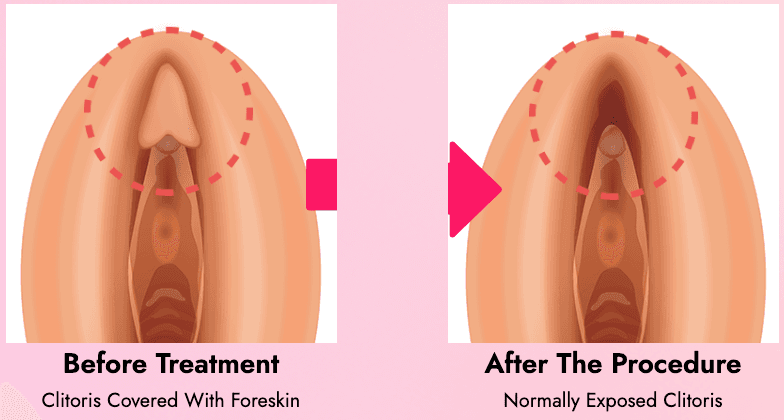
Revision clitoroplasty is an umbrella term rather than one standardized operation. The indication, previous dissection, available tissue, blood supply, location of neurovascular structures, and associated urethral or vaginal work determine the approach.
- Scar revision, adhesion lysis, or hood revision — The surgeon releases scar bands or adhesions and may reshape, advance, reduce, or reconstruct hood tissue to address tethering, a buried glans, excessive exposure, or poor glans coverage. Office lysis, keratin-pearl excision, and surgical or laser release have been described for diagnosed adhesions, but the evidence of benefit is low certainty and recurrence is relevant.
- Nerve- and tissue-preserving re-reduction — In selected CAH/DSD-related cases, the aim is to address residual clitoromegaly or prior malposition while preserving the glans and dorsal neurovascular supply. Long-term feminizing-genitoplasty evidence is observational, heterogeneous, and very low certainty.
- Reconstruction after tissue loss or trauma — Reconstruction can mobilize residual clitoral tissue, release scar, and recreate glans or hood coverage after FGM/C, trauma, or oncologic treatment. The largest body of evidence concerns Foldès-type FGM/C reconstruction and does not directly predict outcomes after cosmetic or gender-affirming surgery revisions; a 2026 review rated certainty for all FGM/C reconstruction outcomes as very low.
- Combined gender-affirming genital revision — Revision after vaginoplasty or vulvoplasty can involve the neoclitoris, hood, labia, urethral meatus, introitus, perineum, or vaginal anatomy. A limited external revision differs substantially from combined urethral or vaginal reconstruction in catheter use, recovery, and risk.
- Energy devices — There is no high-quality comparative evidence that laser, radiofrequency, or a branded energy device is safer or more effective than meticulous conventional revision surgery.
Why Visit Korea for Revision Clitoroplasty?
South Korea has an official framework for foreign-patient services and institution registration that can help international patients verify providers before arranging care. This is useful for travel coordination, but it does not establish a surgeon's experience in this uncommon, indication-specific revision. No reliable published Korea-specific revision-clitoroplasty outcomes, complication benchmarks, or surgeon-volume data show superior results over other countries.
- Institution verification — Use Medical Korea's registered-institution system to check the institution or facilitator. Verify the operating surgeon separately.
- Indication-specific scrutiny — Ask how many revisions for the same underlying indication the surgeon has personally performed, rather than relying on general genital cosmetic-surgery volume.
- Documented emergency pathway — Confirm which hospital department handles bleeding, urinary difficulty, wound problems, or sensory complications after discharge and how after-hours contact works.
- Records for continuity — Request an English operative report, anesthesia record, medication list, pathology report when applicable, and graft or implant details before departure. These documents are essential if care is needed after returning home.
Key Information for International Patients
- Minimum stay — Plan at least 10–14 days in Korea after a limited isolated revision so the team can assess the wound and urination before travel. Plan 2–3 weeks or longer for extensive reconstruction, combined vaginal or urethral surgery, catheter use, wound concerns, or staged follow-up.
- Return flight — There is no procedure-specific evidence defining a safe long-haul-flight interval after isolated revision clitoroplasty. Do not book a fixed return flight until the operating team confirms safe mobility, urination, bleeding control, pain control, and wound status.
- Early recovery — Swelling, bruising, and tenderness are often substantial for 1–2 weeks. Early asymmetry, firmness, numbness, hypersensitivity, or swelling is not the final result; wound healing is commonly reviewed over 4–6 weeks, while scars and sensation can take several months to settle.
- Itinerary impact — Keep the post-operative schedule quiet. Avoid long sightseeing days, tight clothing, prolonged walking, squatting, heavy lifting, cycling, swimming, soaking, strenuous exercise, tampons, penetrative sex, direct clitoral stimulation, and friction until cleared.
- Remote follow-up — Arrange video follow-up before leaving Korea and identify a home clinician able to inspect the wound or coordinate urgent care. Send the home clinician the operative and discharge records.
Travel note: Carry prescribed medicines, discharge documents, and the clinic's direct emergency contact in hand luggage. Changeable flights and accommodation close to the treating hospital reduce disruption if catheter removal, wound review, or treatment of a complication is needed.
Which Are the Best Clinics in Korea for Revision Clitoroplasty?
Listed below are some of the best clinics in Korea for revision clitoroplasty.
1. SH Clinic
For revision clitoroplasty, SH Clinic may be worth discussing with because its women’s health services include labiaplasty and vaginal rejuvenation options, with surgeries and procedures performed directly by an experienced board-certified gynecologist. Your consultation should clarify whether the clinic evaluates and performs revision clitoroplasty specifically, as that procedure is not listed in the available information.
- URL: SH Clinic Website
- Location: Seocho-gu, Seoul
- Women’s health surgical care:
- The clinic lists labiaplasty, vaginoplasty, vaginal tightening, implant surgery, and non-surgical vaginal HIFU among its gynecologic services.
- Its stated approach includes general gynecological care alongside intimate-area treatments.
- Clinician information:
- Surgeries and procedures are stated to be performed directly by a board-certified gynecologist.
- The gynecologist is described as having received a commendation from the Minister of Health and Welfare.
2. Okay Plastic Surgery Clinic
Okay Plastic Surgery Clinic describes individualized aesthetic planning and a team that includes an experienced female plastic surgeon, which may be relevant if you are seeking a careful review of a prior result. However, the available information does not list clitoroplasty, revision clitoroplasty, or gynecologic intimate surgery, so you would need to confirm whether it offers an appropriate evaluation and revision procedure for your specific concerns.
- URL: Okay Plastic Surgery Clinic Website
- Location: Gangnam-gu, Seoul
How Much Does Revision Clitoroplasty Cost in Korea?
Revision Clitoroplasty is listed at ₩5,500,000 (approximately US$4,100). Individual quotes vary because “revision clitoroplasty” can range from a limited adhesion or scar release to a nerve-sparing reconstruction or combined genital revision.
| Procedure Price | Korean Won (₩) | USD ($) |
|---|---|---|
| Low Price | ₩5,500,000 | $4,100 |
| High Price | ₩5,500,000 | $4,100 |
Exchange rate as of 2026-09-06: 1 KRW = 0.000741 USD.
What Affects the Price?
- Extent and type of revision — A limited clitoral adhesion lysis, scar release, or clitoral-hood revision generally requires less dissection than reconstruction after tissue loss, re-reduction or repositioning for clitoromegaly, or repair of substantial scarring. More extensive reconstruction requires longer operating time and greater soft-tissue and neurovascular planning.
- Combined genital or urinary-tract work — Revision involving the labia alone differs from surgery combined with urethral, vaginal, introital, perineal, or vaginoplasty-related correction. Adjacent urethral or vaginal work increases operative scope, may require catheter use, and can require more intensive facility monitoring or admission.
- Anesthesia and postoperative observation needs — A limited revision may be performed with local anesthesia and sedation and allow same-day discharge, while extensive reconstruction may require general anesthesia and postoperative observation. The anesthesia plan and need for monitored recovery use different clinical and facility resources.
- Tissue reconstruction requirements — Cases requiring mobilization of residual clitoral tissue, scar release, hood or preputial reconstruction, or graft-based repair demand additional reconstructive steps and consumables compared with a straightforward release or contour revision.
Cost tip: Request an itemized quote that states what is included, particularly the planned revision technique, anesthesia, operating-room or facility use, any catheter or admission requirements, consumables or graft-related materials if applicable, and scheduled postoperative reviews.
The US$4,100 figure is an approximate conversion using the exchange rate dated 2026-09-06. Check the exchange rate again when budgeting.
Revision Clitoroplasty From Start to Finish
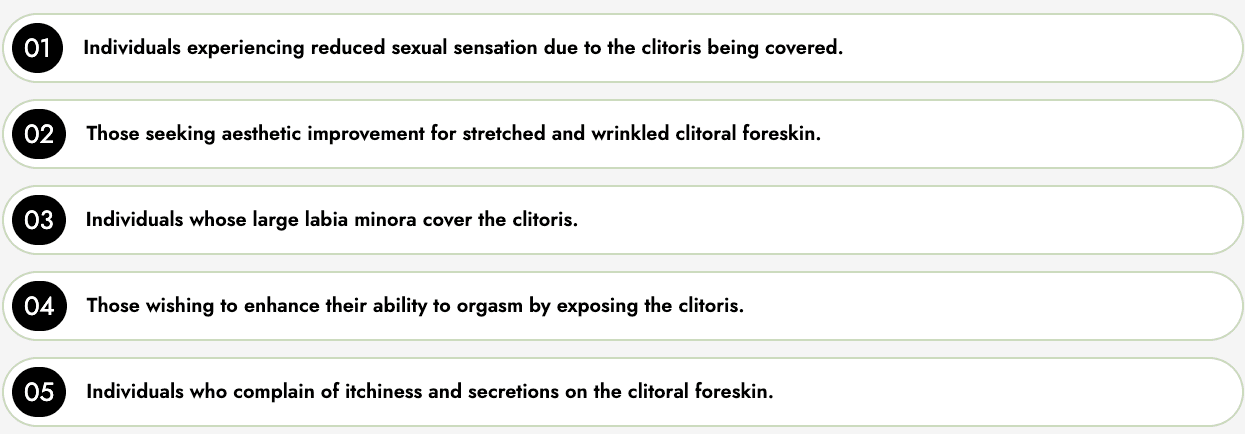
- Remote enquiry and consultation — Send a patient-led description of the problem, goals, prior operative reports, complication history, medication and hormone list, and clear photos only through the clinic's secure process. Confirm whether an English-speaking consultation or qualified interpreter is available; remote review cannot replace physical examination.
- In-person diagnostic assessment — The surgeon reviews scars, adhesions, glans and hood position, tissue quality, tenderness, sensation, labial anatomy, urethral position, and vaginal or pelvic-floor concerns. The key decision is whether symptoms arise from a correctable structure rather than infection, dermatosis, neuropathic pain, pelvic-floor hypertonicity, or broader sexual-health factors.
- Planning, consent, and testing — Discuss the exact proposed repair, tissue limits, possible need to change the plan if operative findings differ, sensory and urinary risks, anesthesia, and likelihood of further revision. Testing can include pregnancy testing when relevant, blood count or chemistry tests based on medical history, urinalysis or culture for urinary symptoms, and anesthesia assessment.
- Travel and admission coordination — Schedule surgery early enough to allow an early wound and urination review before departure. Confirm fasting instructions, transport after anesthesia, accommodation, companion requirements, and an after-hours emergency route.
- Anesthesia and surgery — A limited operation can use local anesthesia with sedation; extensive reconstruction commonly requires general anesthesia. The surgeon releases scar or adhesions, revises or reconstructs hood and soft tissue, repositions tissue, or performs specifically consented labial, urethral, or vaginal work. Catheter use is more likely when surgery includes nearby urethral or vaginal structures.
- Recovery-room assessment and discharge — Limited surgery can allow same-day discharge after safe walking, oral intake, pain control, bleeding assessment, and urination. Extensive reconstruction can require observation or admission.
- Early clinic reviews — Attend a wound and urinary review within days to one week, then further review commonly around 2–6 weeks. The surgeon checks healing, swelling, infection signs, wound separation, urinary function, and whether any catheter can be removed.
- Overseas follow-up — Before leaving, collect records and obtain a written plan for telehealth, wound photographs if requested, medication questions, urgent symptoms, and communication with the home clinician.
Alternatives to Revision Clitoroplasty
The appropriate alternative depends on whether the main problem is a scar or anatomical defect, a urethral or vaginal issue, or pain and sexual symptoms without a surgically correctable cause. Less invasive management avoids additional dissection and scarring, while more extensive reconstruction can address broader anatomical problems but increases recovery demands and risk.
Delayed Reassessment
- Best use — Observation is often appropriate when the prior operation was recent and swelling, firmness, altered sensation, or immature scar may still change substantially.
- Tradeoff — Delaying elective surgery can prevent an unnecessary revision but does not replace urgent treatment for infection, hematoma, necrosis, urinary obstruction, or wound separation.
Adhesion Management
- Best use — Selected patients with diagnosed clitoral adhesions or phimosis can consider office lysis, lysis with keratin-pearl excision, or limited release rather than formal reconstruction.
- Tradeoff — Evidence is low certainty and reported aggregate recurrence is about 31%; laser has not been shown superior to conventional release.
Revision Clitoral-Hood or Labiaplasty Surgery
- Best use — A clitoral hood reduction or revision labiaplasty may be more targeted when the concern is confined to hood or labial tissue rather than the clitoris.
- Tradeoff — Even limited external genital surgery can cause scarring, altered sensation, asymmetry, pain, and need for further correction.
Vaginal or Urethral Revision
- Best use — Consider revision vaginoplasty when urinary stream changes, meatal position, vaginal stenosis, canal concerns, or perineal anatomy are the primary problem.
- Tradeoff — Combined urethral or vaginal reconstruction is more invasive than isolated external revision and often requires longer restrictions, closer surveillance, and sometimes catheter care.
Nonoperative Multidisciplinary Care
- Best use — Pelvic-floor physical therapy, sexual-health or psychosexual therapy, trauma-informed counseling, dermatologic treatment, or neuropathic-pain management are important when pain, arousal, orgasm, or avoidance have multiple contributors.
- Tradeoff — These options do not correct a structural defect, but avoid additional surgical scar and tissue-loss risk when no correctable anatomy is identified.
How Can I Prepare for Revision Clitoroplasty?
- Records and goals — Bring the original operative report when available, prior complication and anesthesia records, and a concise description of what is painful, tethered, exposed, buried, or functionally difficult. Define the exact goal without expecting guaranteed sensation, orgasm, symmetry, or pain relief.
- Medicines and supplements — Disclose every prescription medicine, over-the-counter product, vitamin, herbal supplement, anticoagulant, antiplatelet medicine, NSAID, GLP-1 medicine, steroid, psychiatric medicine, allergy, and estrogen, testosterone, or other gender-affirming hormone. Do not stop prescribed medicines independently; the surgeon, anesthetist, and prescribing clinician must give the individualized adjustment plan.
- Nicotine and alcohol — Stop smoking, vaping, nicotine replacement, and other nicotine exposure for the surgeon-specified interval because nicotine impairs wound healing. Avoid alcohol for the interval set by the anesthesia team.
- Infection and pregnancy disclosure — Report urinary burning, discharge, sores, fever, new bleeding, possible pregnancy, or recent systemic illness before travel. Elective surgery should not proceed until suspected infection or unexplained genital findings are assessed.
- Fasting and hygiene — Follow the clinic's fasting time exactly if sedation or general anesthesia is planned. Clean the area only as instructed and avoid shaving, waxing, fragranced products, antiseptics, or self-applied creams unless the surgeon directs otherwise.
- Practical arrangements — Arrange a companion and transport after sedation or general anesthesia, private accommodation with easy bathroom access, loose breathable underwear and clothing, and flexible return travel. Do not plan cycling, spa visits, water activities, or strenuous tourism.
Travel note: Arrive early enough for in-person assessment and any required tests; remote photographs cannot determine scar depth, tissue mobility, or sensory findings.
Confirm all clinic-specific medicine, fasting, nicotine, testing, companion, and admission requirements with the treating doctor, whose instructions take precedence over general guidance.
Aftercare Advice
Protect the healing tissue from pressure, friction, contamination, and premature sexual activity; early appearance and sensation are not reliable indicators of the final result.
- Cleansing and urination — Use gentle cleansing or a peri-bottle after urination if prescribed, then pat dry rather than rub. Keep the area clean and dry according to the surgeon's instructions.
- Swelling and pain control — Use only surgeon-approved analgesics. Apply a short cloth-wrapped cold pack only if permitted, avoid direct ice contact, stay hydrated, and follow the constipation-prevention plan when pain medicine causes constipation.
- Products and wound contact — Do not apply topical anesthetics, antibiotic ointments, steroid creams, antiseptics, vaginal products, or scar treatments unless specifically prescribed. Wear loose breathable clothing and avoid pressure on the operative area.
- Activity and sexual restrictions — Take gentle short walks rather than prolonged bed rest, but avoid heavy lifting, squatting, gym exercise, cycling, horseback riding, swimming, baths, hot tubs, tampons, penetration, direct clitoral stimulation, and friction until the surgeon confirms healing. Comparable external genital repairs commonly require at least 4–6 weeks of abstinence and restriction, while urethral, vaginal, graft, or extensive reconstruction can require longer.
- Warning signs — Seek urgent assessment for rapidly increasing swelling, a tense expanding mass, persistent or heavy bleeding, fever, worsening redness, foul drainage, wound separation, black or gray tissue, inability to urinate, uncontrolled pain, chest pain, shortness of breath, or calf swelling. Report new or persistent numbness, hypersensitivity, dysesthesia, painful engorgement, or clitoral pain promptly.
- Follow-up and final assessment — Attend scheduled early and later reviews, including remote follow-up after returning home. Scars, contour, pain, and sensation can take several months to mature; do not schedule further revision solely because of early swelling, firmness, asymmetry, or altered sensation.
Follow the treating doctor's individualized instructions and contact the clinic promptly when healing appears abnormal or symptoms worsen.
Frequently Asked Questions
Related Blogs
G-spot Filler in Korea: Evidence, Safety, Recovery, and Travel Planning
G-spot filler involves nonstandardized anterior vaginal-wall injections, most often temporary hyaluronic acid, with uncertain sexual-function benefits and potential risks. International patients should plan 2–3 days in Korea for assessment and review, obtain treatment records, and arrange follow-up care.
Updated: Sep 28, 2026
PRP Vaginal Rejuvenation in Korea: Evidence, Procedure Steps, Recovery and Travel Planning
PRP vaginal rejuvenation uses a patient’s processed blood plasma for targeted vaginal, vulvar, clitoral, or periurethral injections after pelvic-health assessment, but protocols and evidence of benefit are not standardized. The article covers candidate screening, Korea travel planning, preparation, recovery, warning signs, follow-up, and diagnosis-specific alternatives for dryness, pain, incontine
Updated: Sep 28, 2026
G-spot Amplification in Korea: Evidence, Safety, Recovery and Travel Planning
G-spot amplification involves injecting filler into a patient-identified area of the anterior vaginal wall near the urethra, but no standardized target or proven sexual-function benefit exists. The article covers candidacy, product and clinic verification in Korea, travel planning, aftercare, warning signs, and alternatives such as sexual-health evaluation and pelvic-floor therapy.
Updated: Sep 28, 2026
Viveve Laser in Korea: RF Treatment, Safety, Evidence and Travel Planning
Viveve is a non-incisional, cryogen-cooled monopolar RF treatment—not a laser—used in selected patients after gynecologic assessment, with limited evidence for vaginal-laxity symptoms and no established cure for incontinence. International patients considering treatment in Korea can review candidate criteria, MFDS device verification, outpatient recovery, 10-day intercourse and tampon restrictions
Updated: Sep 22, 2026