
Medical Tourism Blog
Airjet Lifting in Korea: Treatment Methods, Recovery, Risks, and Travel Planning
Table of contents
- Airjet Lifting at a Glance
- What Is AirJet Lifting?
- Who Is a Good Candidate for AirJet Lifting?
- How Is AirJet Lifting Performed?
- Why Visit Korea for AirJet Lifting?
- Key Information for International Patients
- Which Are the Best Clinics in Korea for Airjet Lifting?
- Airjet Lifting From Start to Finish
- Alternatives to AirJet Lifting
- How Can I Prepare for AirJet Lifting?
- Aftercare Advice
Considering treatment in Korea? Everything you need to know e.g. — how to avoid scams, visas, interpreters, recovery tips — in our Medical Tourism Master Guide. Plan with confidence in minutes, not weeks!
Last updated: September 2026
Airjet Lifting at a Glance
- What it is — AirJet Lifting is a needle-free pneumatic jet procedure that uses high-pressure liquid delivery through the skin for modest dermal remodeling, such as fine lines, crepey texture, early laxity, and selected depressed scars.
- Best candidates — It is best suited to adults seeking subtle, low-downtime improvement in early skin laxity, texture, pores, or selected rolling scars—not people with heavy jowls, major facial descent, excess skin, or facelift-level lifting goals.
- Results take time — Immediate fullness or tightening can be caused by fluid deposition and swelling, so a more meaningful result assessment is usually 1–3 months after the final planned session; no standardized AIRJET II longevity or repeat-treatment interval is established.
- Recovery — Most people have little social downtime, but redness, pinpoint swelling or wheals, tenderness, bruising, and edema can remain visible for several days; avoid heat, alcohol, strenuous exercise, and direct sun for the first 24–48 hours.
- Korea travel plan — Plan 1–2 days in Korea for consultation and treatment, or 2–3 days for extensive work, filler-like solutions, or combination procedures; there is no established AirJet-specific no-fly interval, so departure should be cleared by the treating clinician.
- Korea-specific check — In Korea, AirJet commonly refers to Union Medical’s AIRJET or AIRJET II platform, but the name does not specify the injected solution or protocol—confirm the exact device model, solution brand and lot, volume, settings, shot count, and treatment sites before booking.
- Key limitation and risk — Needle-free does not mean risk-free: the jet breaches the skin barrier, and outcomes and complications depend on the solution, facial area, and technique; AIRJET-specific evidence is limited to a small uncontrolled study and does not prove SMAS lifting or facelift-equivalent results.
What Is AirJet Lifting?
AirJet Lifting is a needle-free pneumatic treatment that uses high-pressure liquid jets to support skin remodeling. It aims for subtle improvement in fine lines, texture, early laxity, and selected depressed scars rather than facelift-level lifting. It is a minimally invasive procedure because the jet passes solution through the skin without a conventional needle.
Who Is a Good Candidate for AirJet Lifting?
- Early laxity and fine lines — Adults seeking modest improvement in fine wrinkles, crepey texture, enlarged pores, or early loss of skin firmness rather than a surgical lift.
- Selected depressed scars — Some rolling or tethered atrophic acne scars can be considered when an in-person assessment confirms that pneumatic treatment is appropriate.
- Low-downtime priorities — Suitable candidates accept short-term redness, tenderness, pinpoint swelling, bruising, or edema and do not need an immediate event-ready result.
- Realistic treatment goals — Good candidates understand that AirJet is protocol-dependent and that any collagen-remodeling change is gradual, variable, and less pronounced than facelift surgery.
Avoid treatment over active infection, inflamed acne, dermatitis, open wounds, or active cold sores until the area is controlled. Elective treatment is generally deferred during pregnancy or breastfeeding, and a known allergy to the proposed solution or lidocaine requires a different plan or exclusion; “AirJet” does not identify one standard solution. Significant skin excess, heavy jowls, pronounced facial-fat descent, or a facelift-level lifting goal require a surgical assessment because pneumatic dermal treatment does not remove skin or reliably reposition deep facial structures. The clinician must also assess prior filler, threads, implants, facial surgery, keloid tendency, autoimmune or inflammatory disease, immunosuppression, poorly controlled diabetes, recurrent herpes, bleeding disorders, and anticoagulant or antiplatelet use.
How Is AirJet Lifting Performed?
AirJet Lifting has no universally standardized patient-facing types. The practical distinction is the treatment target, the delivered solution, and whether it is part of a combination plan.
- Facial or neck dermal remodeling — The operator distributes high-pressure pneumatic shots across selected skin areas for fine lines, texture, thin or crepey skin, and mild laxity. Published jet-injection protocols have used saline, glucose-based solutions, and non-cross-linked or cross-linked hyaluronic acid (HA), which have different effects and risks.
- Focused scar remodeling — Concentrated treatment is used for selected depressed scars, with the aim of mechanically affecting tethered tissue while delivering solution. It is conceptually related to subcision but is not interchangeable with needle or cannula subcision.
- Scalp or temporal-vector treatment — Some Korean-market protocols target the scalp or temples to pursue contour or lifting effects. Evidence for these approaches is limited, and combination plans cannot show how much improvement came from AirJet itself.
- Combination treatment — Clinics can pair AirJet with HIFU, radiofrequency, laser, microneedling, botulinum toxin, or conventional filler. Review the recovery, contraindications, and evidence for the complete plan, not the AirJet component alone.
- Pressure and depth selection — A small AIRJET report described superficial and deeper approaches and found that nominal pressure influenced tissue distribution, while actual delivery varied with skin characteristics. This supports individualized technique, not a universal setting or facial map in the limited AIRJET-specific evidence.
Why Visit Korea for AirJet Lifting?
In Korea, “AirJet Lifting” commonly refers to Union Medical’s AIRJET or AIRJET II needle-free pneumatic platform. Confirm the exact device and the solution before booking: the marketing term does not establish a fixed protocol, material, or expected duration. Korea’s device-regulatory system provides a route for verifying medical-device certificates, but this alone does not confirm the current authorization or intended indication of a particular AIRJET II unit.
- Korean-associated platform — Union Medical presents AIRJET II as a pneumatic device that uses a dedicated nozzle and syringe kit to momentarily deliver solution through the skin and claims a subcision-like effect. This manufacturer description explains the intended presentation of the device, not clinical superiority or facelift-equivalent results.
- Protocol transparency — Ask for the device model, solution brand, lot number, planned volume, pressure or setting, shot count, and anatomical sites. This is particularly important because published pneumatic-jet research uses differing machines, solutions, pressures, and indications.
- Regulatory verification route — The Korean MFDS describes technical-documentation and medical-device certificate-verification processes. Request the exact Korean certificate or license details from the clinic or manufacturer rather than assuming that a device name confirms its status.
- Candid evidence limit — AIRJET-specific research includes a small uncontrolled report with 81 enrolled participants and 72 completers, subjective assessments, and limited follow-up. It does not prove direct SMAS lifting, superiority to HIFU or radiofrequency, or equivalence to facelift surgery.
Key Information for International Patients
- Minimum stay — Plan 1–2 days for an in-person assessment and treatment. Stay 2–3 days when extensive facial or scar work, a filler-like solution, notable bruising risk, or combination treatment is planned.
- Flight timing — No authoritative AirJet-specific no-fly interval was identified. Base departure timing on the delivered solution, treated sites, swelling or bruising, and any sedation or combined procedure; obtain clearance from the treating clinician before flying.
- Repeat sessions — A multi-session plan can be proposed, but no standardized AIRJET II interval is established. In a retrospective study of a different high-velocity HA jet-injector, patients had an average of 2.8 treatments and were assessed at three months; this cannot be used as an AIRJET II schedule or duration guarantee.
- Itinerary impact — Most people have little social downtime, but redness, wheals, tenderness, edema, and bruising can be visible for several days. Do not schedule a major event, long outdoor itinerary, sauna visit, or strenuous activity immediately afterward.
- Companion and transport — A companion is usually unnecessary without sedation. Arrange one and do not drive when oral anxiolytics, sedating analgesics, or a nerve block is planned.
- Remote follow-up — Leave Korea with the treatment record, including device/model, solution and lot number, volume, settings, sites, photographs, aftercare instructions, and an urgent clinic contact. Arrange photo or video review at about 1–2 weeks and again 1–3 months after the final session.
Travel note: Build flexibility into return flights. Significant swelling, increasing pain, an allergic reaction, or a volumizing injectable warrants clinical review before departure.
Which Are the Best Clinics in Korea for Airjet Lifting?
Listed below are some of the best clinics in Korea for airjet lifting.
1. Cheongdam Oracle Dermatology & Plastic Surgery Clinic
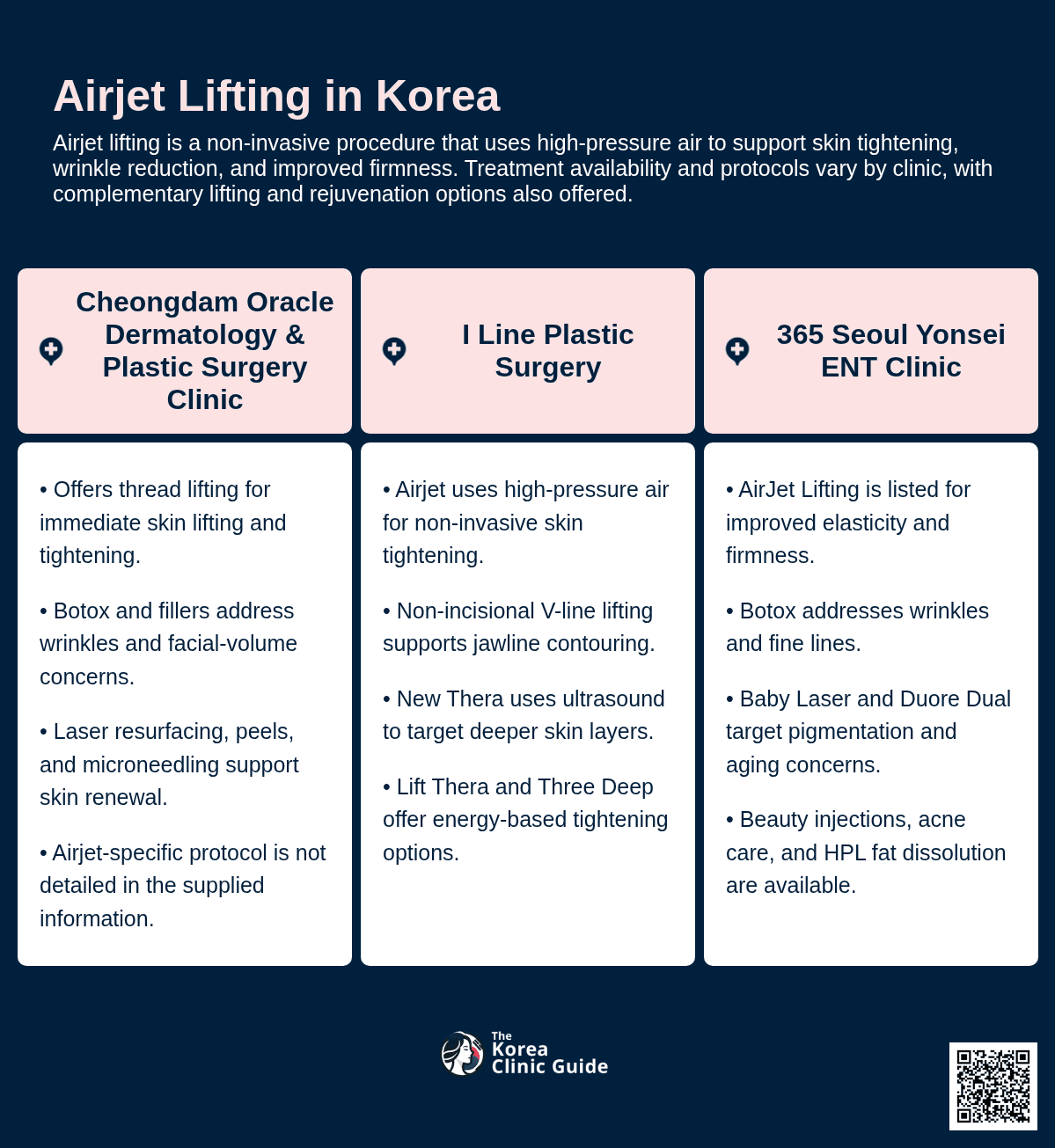
If you are exploring Airjet Lifting, this clinic’s documented non-surgical lifting option is thread lifting, which uses threads to lift and tighten the skin with immediate results and minimal downtime; the supplied information does not specify an Airjet protocol.
- URL: Cheongdam Oracle Dermatology & Plastic Surgery Clinic Website
- Location: Gangnam-gu, Seoul
- Lifting and rejuvenation:
- Thread lifting is offered as a non-surgical option to lift and tighten skin.
- Botox and dermal fillers are available for wrinkle reduction and facial-volume concerns.
- Facelift surgery is listed for deeper wrinkles and sagging involving facial skin and underlying tissues.
- Skin treatments:
- Laser resurfacing is offered for texture concerns, wrinkles, scars, and blemishes.
- Chemical peels address exfoliation, sun damage, pigmentation, and mild scarring.
- Microneedling is listed to support collagen production, texture, and firmness.
- HydraFacial combines cleansing, exfoliation, and hydration.
2. I Line Plastic Surgery
For Airjet Lifting, you can expect a non-invasive treatment using high-pressure air to tighten skin and reduce wrinkles, positioned as an alternative to traditional lifting methods. The clinic also lists other non-surgical options that address skin laxity and facial contouring.
- URL: I Line Plastic Surgery Website
- Location: Gangnam-gu, Seoul
- Procedure details:
- Airjet is described as using high-pressure air for skin tightening and wrinkle reduction.
- It is presented as a non-invasive lifting option.
- Related lifting options:
- Non-incisional V-line lifting is available for jawline tightening and contouring.
- New Thera uses ultrasound to target deeper skin layers for lifting and tightening and to promote collagen production.
- Lift Thera uses thermal energy for skin tightening and a mild lift without downtime.
- Autologous blood stem cell regeneration is listed to support healing, skin texture, and scar improvement.
- Skin treatments:
- Pore/tightening treatments are available for enlarged pores and smoother-looking skin.
- Omega is a light-based treatment for pigmentation, acne, and aging-related concerns.
- Three Deep is a radiofrequency treatment intended to reach deeper skin layers for tightening and rejuvenation.
3. 365 Seoul Yonsei ENT Clinic
For AirJet Lifting, you can expect a non-invasive skin-lifting and tightening procedure intended to improve skin elasticity and firmness through the clinic’s skin and obesity service.
- URL: 365 Seoul Yonsei ENT Clinic Website
- Location: Seongnam-si Bundang-gu, Gyeonggi
- Procedure details:
- AirJet Lifting is listed as a non-invasive option for skin lifting and tightening.
- The stated goals are improved skin elasticity and firmness.
- Related skin and aesthetic services:
- Botox is available for wrinkles and fine lines.
- Baby Laser and Duore Dual are listed for concerns including pigmentation and fine lines.
- Beauty injections are offered to support skin texture, hydration, and overall appearance.
- Lucid Acne Care is available for acne management.
- HPL fat dissolution is listed for localized fat deposits.
Airjet Lifting From Start to Finish
- Remote enquiry and screening — Send standardized unfiltered front, oblique, and profile photographs, plus a full medical history. Ask whether English-language or virtual consultation is available and request the device model, intended solution, target sites, session plan, estimated appointment length, anesthesia plan, and post-treatment restrictions.
- Pre-travel treatment planning — Disclose prior fillers, fat grafting, threads, implants, facial surgery, energy-based procedures, allergy history, recurrent cold sores, autoimmune disease, tendency to bruise, and all medicines and supplements. Do not book solely on a marketed “lifting” claim.
- In-person assessment — The clinician examines skin quality, laxity, asymmetry, scar type, volume loss, facial-fat descent, and skin excess. Baseline photographs and consent should distinguish immediate fluid-related swelling from the final result and explain that AirJet is not a surgical facelift.
- Solution and safety confirmation — Confirm the exact solution, its brand and lot number, expected role as a skin booster or volumizing material, and relevant allergy risks. When local anesthetic is included, confirm whether lidocaine is present.
- Preparation on treatment day — The area is cleansed and marked. Anesthesia varies: some protocols use none, while treatment discomfort depends on pressure, volume, solution, and anatomical site; topical anesthetic, a nerve block, or sedation changes transport and fasting requirements.
- Pneumatic delivery — The clinician uses the device nozzle to deliver a pattern of high-pressure liquid jets through the skin into selected tissue planes. Treatment time is not standardized and depends on the number of sites, shot count, indication, and combined procedures.
- Immediate review and discharge — The clinician checks the treated area and provides written aftercare. Most patients leave the same day, but substantial swelling, pain, bruising, or a filler-like solution can justify a next-day review before international travel.
- Overseas follow-up — Send photographs at the clinic’s requested intervals, commonly around 1–2 weeks and 1–3 months. Seek urgent local care and notify the Korean clinic for severe or escalating symptoms rather than waiting for a remote appointment.
Alternatives to AirJet Lifting
The best alternative depends on what causes the concern. Energy-based treatments can suit mild laxity without an injected solution; scar procedures address tethering and surface texture more directly; surgery provides stronger correction for major descent or excess skin but requires a much longer recovery.
HIFU or Ultrasound Lifting
- Best suited to — Mild-to-moderate laxity where the priority is non-injectable tightening.
- Tradeoff — HIFU lifting and Ultherapy do not place solution in the skin, but results remain gradual and do not equal surgical repositioning.
Radiofrequency Tightening
- Best suited to — Mild laxity, texture concerns, and patients considering heat-based dermal remodeling.
- Tradeoff — Thermage and InMode lifting use different energy approaches; treatment intensity, discomfort, and recovery differ from pneumatic injection.
RF Microneedling
- Best suited to — Texture, pores, and some acne-scar concerns where controlled needle injury plus radiofrequency is appropriate.
- Tradeoff — Secret RF microneedling uses needles and has separate pigmentary, scarring, and energy-related risks.
Conventional Scar Treatment
- Best suited to — Tethered rolling scars or mixed scar patterns needing a scar-specific plan.
- Tradeoff — Acne scar treatment can combine conventional subcision, fractional laser, focal methods, and other techniques. Ice-pick scars often need focal treatment rather than AirJet alone.
Filler, Thread Lift, or Facelift
- Best suited to — Filler for volume loss, thread lift for selected mechanical lifting goals, and facelift surgery for substantial jowling, descent, or excess skin.
- Tradeoff — Facial filler addresses volume rather than skin tightening. A face thread lift and face lift can create more visible lifting, while facelift surgery entails incisions, anesthesia, and materially longer recovery.
How Can I Prepare for AirJet Lifting?
- Disclose medicines and supplements — Report warfarin, aspirin, clopidogrel, apixaban, rivaroxaban, NSAIDs, vitamin E, fish oil/omega-3, garlic, ginger, ginkgo, St. John’s wort, corticosteroids, isotretinoin, immunosuppressants, and all prior injectables. Do not independently stop prescribed anticoagulants or antiplatelet medicines; the prescribing clinician and treating doctor must make an individualized plan.
- Clear active skin problems — Postpone treatment for sunburn, infected lesions, active cystic acne, dermatitis, open wounds, or cold sores in the treatment zone. Ask about antiviral prevention when recurrent herpes labialis and treatment around the mouth are relevant.
- Protect the treatment area — Avoid aggressive exfoliation, waxing, retinoids, strong acids, scrubs, and abrasive home devices on planned sites unless the clinic directs otherwise. Attend with clean skin and avoid unapproved topical anesthetics.
- Confirm fasting and sedation rules — Fasting is generally unnecessary without sedation. Follow the clinic’s exact instructions when sedation, analgesic medication, a nerve block, or a combined procedure is planned.
- Avoid alcohol and major heat exposure — Do not arrive dehydrated or with a sunburn. Follow the clinic’s alcohol and sun-exposure instructions, especially where bruising, swelling, or combined energy treatment is expected.
- Plan transport and accommodation — Stay near the clinic for the first night after extensive treatment, avoid a demanding sightseeing schedule, and keep flights flexible. Arrange a companion and private transport when sedating medication or a nerve block is planned.
Travel note: Request the treatment record and emergency contact before the appointment, not after leaving Korea.
Confirm all clinic-specific medicine, fasting, skincare, smoking, alcohol, and travel requirements with the treating doctor; individualized instructions take precedence over general guidance.
Aftercare Advice
Protect the treated skin, avoid pressure and heat while swelling settles, and treat worsening pain or color change as urgent rather than cosmetic.
- Do not press or massage — Avoid rubbing, massage, scrubs, facial devices, home needling, or home jet-injection devices on treated areas until the clinician approves. Use only the cleanser, moisturizer, ointment, or topical treatment supplied or recommended by the clinic.
- Restrict heat and exertion — Avoid vigorous exercise, sauna, hot baths, alcohol, intense heat, and direct sun for the first 24–48 hours when they worsen redness or swelling. Follow longer restrictions when AirJet was combined with another procedure.
- Restart active skincare carefully — Do not use retinoids, exfoliating acids, scrubs, or other irritating products until redness and tenderness resolve and the clinic approves resumption. Once the skin barrier is intact, use broad-spectrum SPF 50 sunscreen and limit direct sun exposure.
- Expect temporary changes, not final results — Redness, wheals, pinpoint swelling, tenderness, bruising, and edema can occur immediately and generally settle over several days. In a 115-patient retrospective series using a different jet-injector platform, bruising occurred in 7% and temporary local edema in 1%; these rates do not establish AIRJET II risk across solutions or facial zones.
- Watch for urgent warning signs — Seek urgent in-person care for severe or escalating pain, rapidly spreading redness, fever, pus, blistering, marked one-sided swelling, pale, gray, or blue skin, visual symptoms, facial weakness, hives, wheezing, lip or tongue swelling, faintness, or neurologic symptoms. Notify the treating clinic immediately.
- Schedule outcome review — Do not judge the result from immediate swelling. Reassess about 1–3 months after the final planned session, with earlier photo or video follow-up if symptoms arise.
Follow the treating doctor’s instructions over this general guidance and contact the clinic promptly when something appears wrong.
Frequently Asked Questions
Related Blogs
Nipple Whitening Treatment in Korea: Methods, Safety, Recovery, and Travel Planning
Nipple whitening involves clinician assessment, possible topical therapy, test-spot laser/light treatment, superficial peels, resurfacing, or camouflage micropigmentation, with limited direct evidence for nipple–areola lightening. International patients should plan 2–3 days for examination and possible treatment, arrange follow-up, and defer cosmetic care for suspicious skin changes, pregnancy, br
Updated: Sep 22, 2026
Juvelook Volume Filler in Korea: Results, Safety, Recovery, and Travel Planning
Juvelook Volume uses staged deep-plane PDLLA/HA injections for gradual correction of nasolabial folds and localized facial volume loss. International patients can review candidacy, three-session scheduling, recovery, travel planning, aftercare, and urgent warning signs.
Updated: Sep 22, 2026
EmSculpt Fat Dissolving Laser in Korea: EMSCULPT NEO Treatment, Recovery, Results and Travel Planning
EMSCULPT NEO combines electromagnetic muscle contractions with radiofrequency heating in a commonly studied course of three or four 30-minute sessions over 2–4 weeks. International patients can find screening criteria, Korea travel planning, device verification, aftercare, warning signs, and alternatives to noninvasive body contouring.
Updated: Sep 22, 2026
TruSculpt Fat Dissolving Laser in Korea: RF Body Contouring, Results, Recovery and Travel Planning
TruSculpt RF uses external radiofrequency applicators to heat localized, pinchable fat for gradual contour refinement, with results typically assessed at 8–12 weeks. The article covers candidacy, contraindications, Korea travel planning, device verification, treatment steps, recovery, aftercare, and alternatives.
Updated: Sep 22, 2026
Clinics offering Airjet Lifting

Cheongdam Oracle Dermatology & Plastic Surgery Clinic in Korea: Offering Advanced Skin, Anti-Aging, Body Contouring Treatments and More
Seolleung

I Line Plastic Surgery: Premier Destination for Precision Eyelid and Nose Surgery in Korea
Cheongdam
Seoul Reshine Clinic in Korea: Advanced Aesthetic, Dermatology, and Skin Care Services
Seolleung

Beautiful Clinic in Korea: Comprehensive Aesthetic and Medical Procedures for Enhanced Beauty and Confidence
Konkuk University